In short
- Most clinics charge per session, by the size of the tattoo. As a rough guide in Europe, a small tattoo costs about €50–150 per session, a palm-sized one €100–250 and one up to 25 cm €200–450. US prices are usually higher.
- The number of sessions matters more than the price of one. Many professional tattoos need around 6 to 12, spaced six to eight weeks or more apart, so the total is often several times what people expect.
- Colourful tattoos, picosecond lasers, doctor-led clinics and big cities usually cost more per session. Packages of several sessions often bring a 10–20% discount.
- Very cheap offers are risky: a weak laser or an untrained operator can mean more sessions, burns or scars, which cost far more to fix than you saved.
In this article 9
Tom had three quotes on his kitchen table for the same tattoo: a twelve-centimetre line of script on his forearm, done in his early twenties, in a font he now finds hard to look at. The first clinic, a dermatology practice, quoted €180 per session. The second, a specialist laser studio, said €110. The third was an online deal: €49 a session, “unlimited sessions for one price”, valid until Sunday. Same tattoo, same city, prices almost four times apart. Which one was the real price?
All three, in a way. Laser tattoo removal has no fixed price list, and the number on a website tells you surprisingly little about what you will pay in the end. This guide walks through typical prices per session by tattoo size, how many sessions to expect, what makes removal cheaper or dearer, and how to tell a fair package from a trap.
> A note on the numbers and pictures: the prices here are rough ranges collected from clinic price lists and consumer guides in 2025–2026. They vary a lot by country, city and clinic. Always ask for a written quote. The images are illustrations made to show typical situations. They are not photos of real patients or real results.
The short answer
Most people pay somewhere between a few hundred and a few thousand euros or dollars in total for laser tattoo removal. A small, simple black tattoo can end up at a few hundred. A large, colourful piece can go well above five thousand. The price of one session depends mainly on the size of the tattoo; the total depends mainly on how many sessions it needs.
That is why two people with the same per-session price can end up paying very different amounts. One tattoo fades nicely in six sessions; another, the same size, needs twelve. Before you compare clinics, it helps to understand both halves of the sum.
Removal calculatorLaser tattoo removal calculator: how many sessions and what it costsRead alsoLaser tattoo removal: what to really expectWhat one session costs, by size
Almost every clinic prices by area. Some use size classes such as small, medium and large; others charge per square centimetre or per square inch. The ranges below are typical for Europe and the US. They are not quotes, but they show the order of magnitude you can expect.
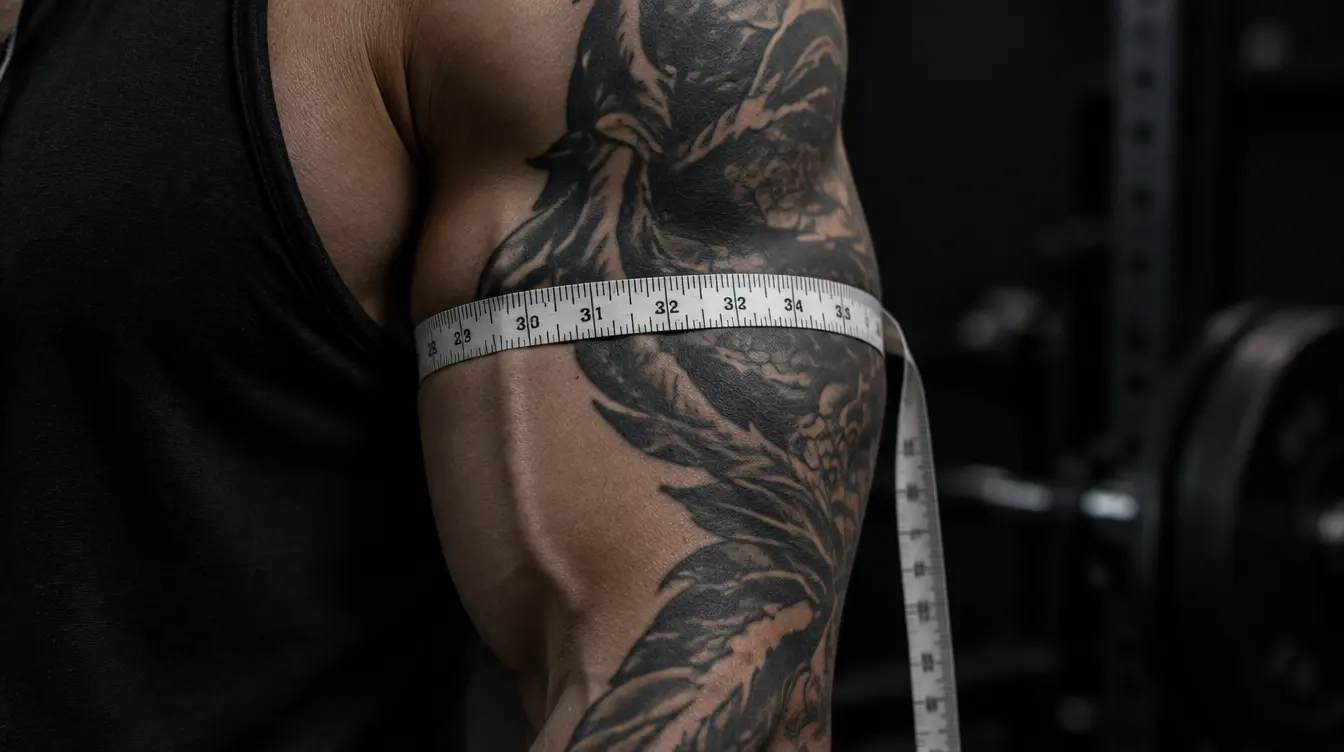
- Small, up to about 5 cm (up to roughly 25 cm², from a coin to a matchbox): about €50–150 per session in Europe, about $100–300 in the US.
- Medium, around 10 cm (up to roughly 100 cm², about the size of a palm): about €100–250 per session in Europe, about $200–450 in the US.
- Large, up to about 25 cm (half a forearm, a calf piece, a shoulder blade): about €200–450 per session in Europe, about $400–800 in the US.
- Very large (a half sleeve, a full sleeve, a back piece): often €400–1,000 or more per session in Europe and $700–1,500 or more in the US. Many clinics quote these individually or split them over several appointments.
Prices also differ a lot between countries. In Poland or Spain a small tattoo can start under €50 per session, while in Scandinavia, Switzerland, Ireland or big US cities the same tattoo can cost two or three times as much. Within one city, dermatology practices usually sit at the top of the range and specialist laser studios in the middle.
Why the number of sessions matters more
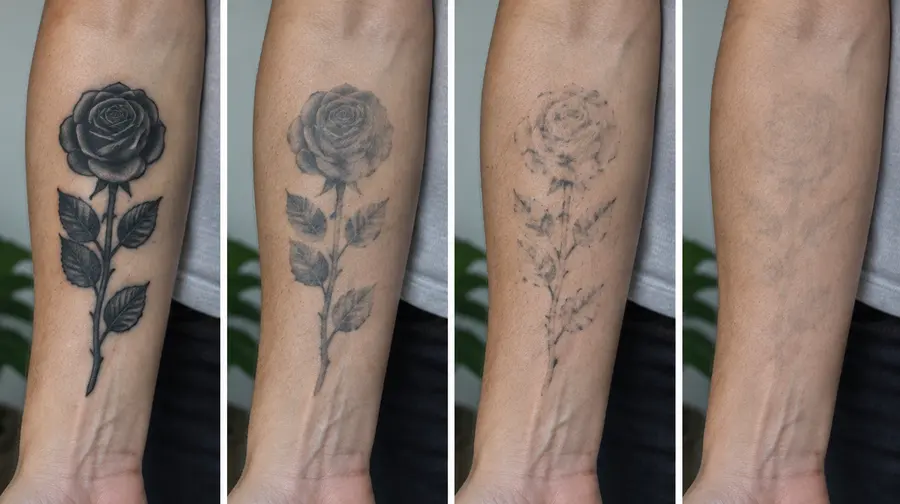
Laser removal does not erase a tattoo in one go. Each session breaks part of the ink into smaller particles, and the body clears them away slowly over the following weeks. Then the next session breaks up the next layer. Sessions are usually spaced at least six to eight weeks apart, often longer, so removal typically takes one to two years.
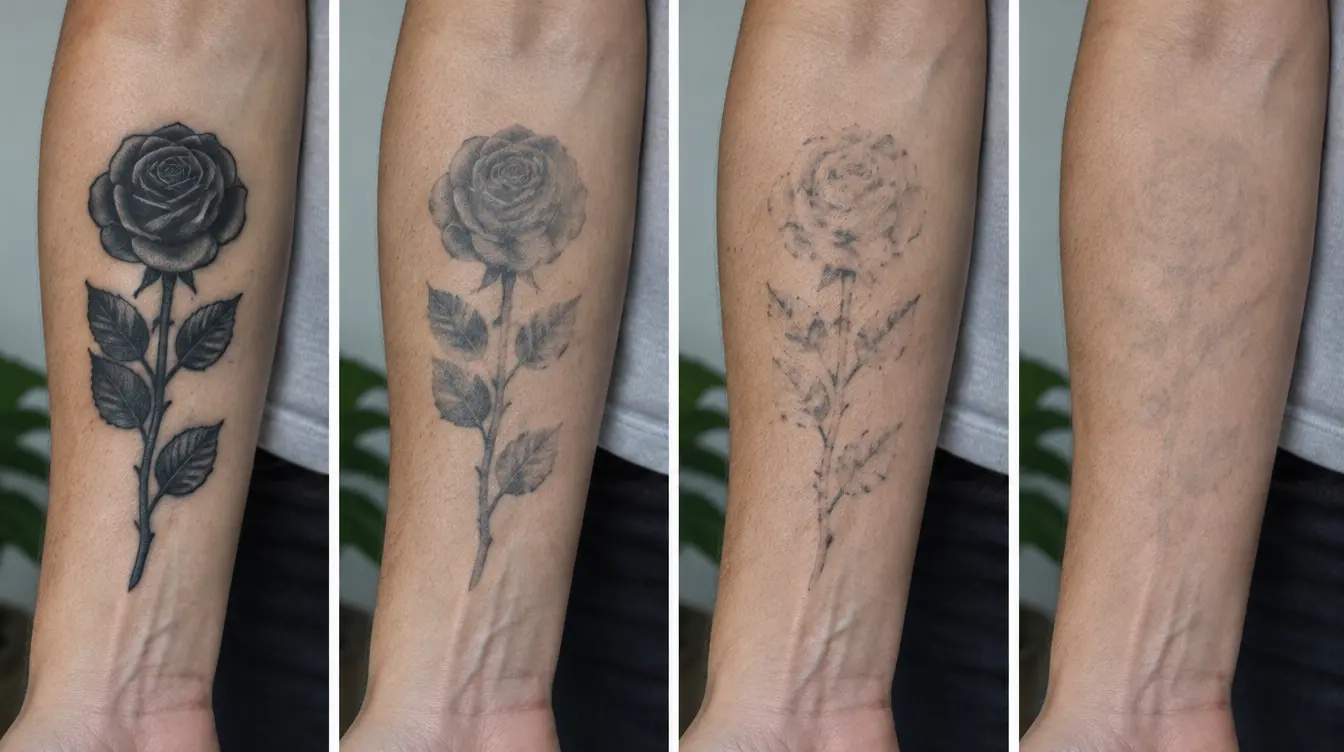
How many sessions you need depends on the ink, its depth, the colours, your skin and where the tattoo sits on the body. As a very rough guide:
- Thin, older or amateur tattoos with little ink often fade in fewer sessions, sometimes around four to six.
- Most professional black tattoos need somewhere around six to twelve.
- Dense, layered or colourful work, and cover-ups, can need more than twelve, and some colours may never disappear completely.
Multiply that by the per-session price and you get the honest total. A small tattoo at €80 per session over eight sessions is €640. A palm-sized tattoo at €180 over ten sessions is €1,800. A large piece at €350 over twelve sessions is €4,200. In US dollars the same three examples typically land somewhere around $1,200, $3,000 and $6,000 or more.
The price of one session is the headline. The number of sessions is the bill.
This is also why a clinic that is honest about the number of sessions is worth more than one that simply looks cheaper. Ask every clinic how many sessions they expect for your tattoo, and what they base that on. If one says three and another says ten for the same professional black tattoo, the first one is probably telling you what you want to hear.
What makes removal cheaper or dearer
Colours
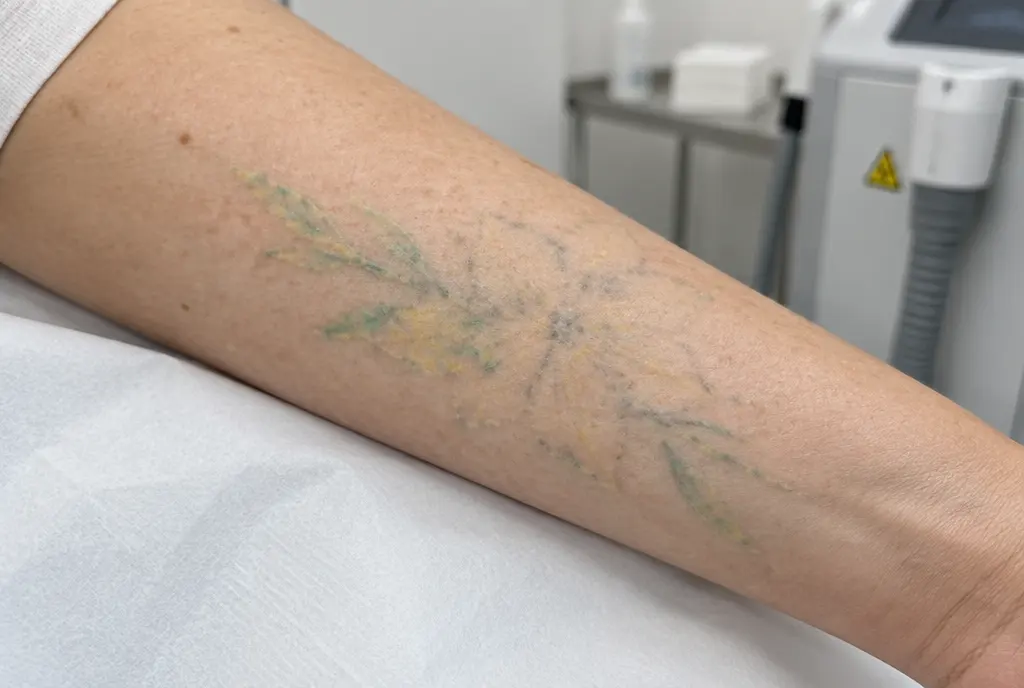
Black is the easiest colour to remove and usually the cheapest. Each laser wavelength is absorbed best by certain colours, so red, blue, green and especially yellow, light pink and white need different wavelengths, more sessions, or both. Some clinics charge a surcharge for colour, and even when they do not, a colourful tattoo usually needs more appointments. A plain black tattoo and a colourful one of the same size can easily end up a few hundred euros apart in total.
The laser: Q-switched or picosecond
Most removal is done with one of two families of lasers. Q-switched lasers (often Nd:YAG) send pulses lasting billionths of a second and have been the standard for decades. Picosecond lasers send pulses about a thousand times shorter. Sessions on a picosecond laser often cost more, by about 20–50% at many clinics, because the machines are expensive to buy and run.
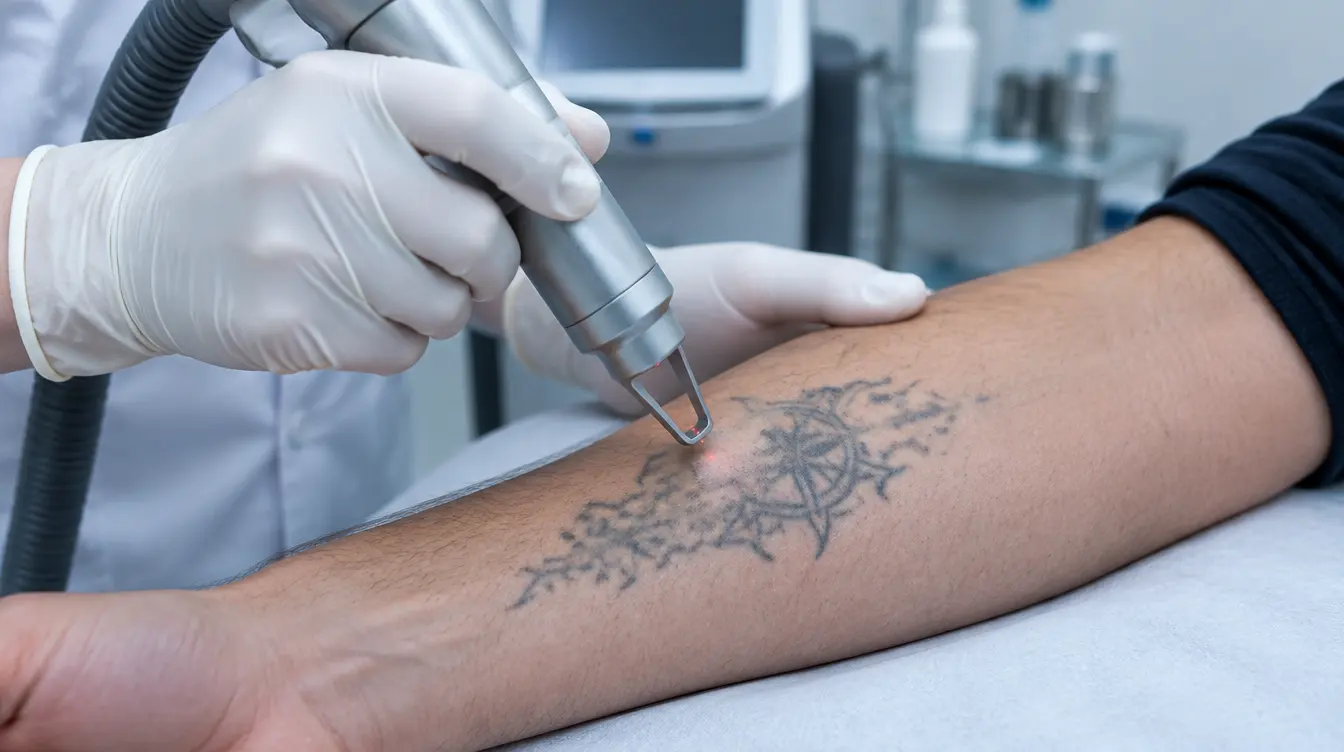
Many clinics advertise that picosecond lasers need fewer sessions. The research so far is more careful: reviews suggest picosecond lasers work better on some colours, such as blue and green, but there is no clear proof that they need fewer sessions for ordinary black ink. For a simple black tattoo, a well-run Q-switched treatment can be just as good value. For stubborn colours, a picosecond laser may be worth the higher price.
Who treats you
In some countries the choice is partly made for you. In Germany, laser tattoo removal has been reserved for doctors with the right training since 31 December 2020. In France, removal is officially a medical procedure as well, even though not every provider follows the rule. Elsewhere, specialist laser studios, beauty clinics and dermatologists all offer it. Doctor-led clinics usually charge more, but they can also judge your skin, deal with complications and handle difficult cases such as allergic reactions to old ink.
Everything else
- City and country. Rent and wages show up in the price. Capital cities are usually the most expensive.
- Where on the body. Tattoos on the hands, feet and lower legs often fade more slowly because circulation there is weaker, which can add sessions.
- Numbing. Numbing cream or cooling is often included, but some clinics charge for it, and injected local anaesthetic can cost extra.
- Consultation and test patch. Many clinics include the first consultation; some charge a small fee and take it off the first session.
Package deals and how to read them
Many clinics sell packages: for example four or six sessions paid in advance, often with a discount of about 10–20%. Some offer an “unlimited” price for one tattoo. A good package can save real money. A bad one ties you to a clinic you may no longer want to visit.
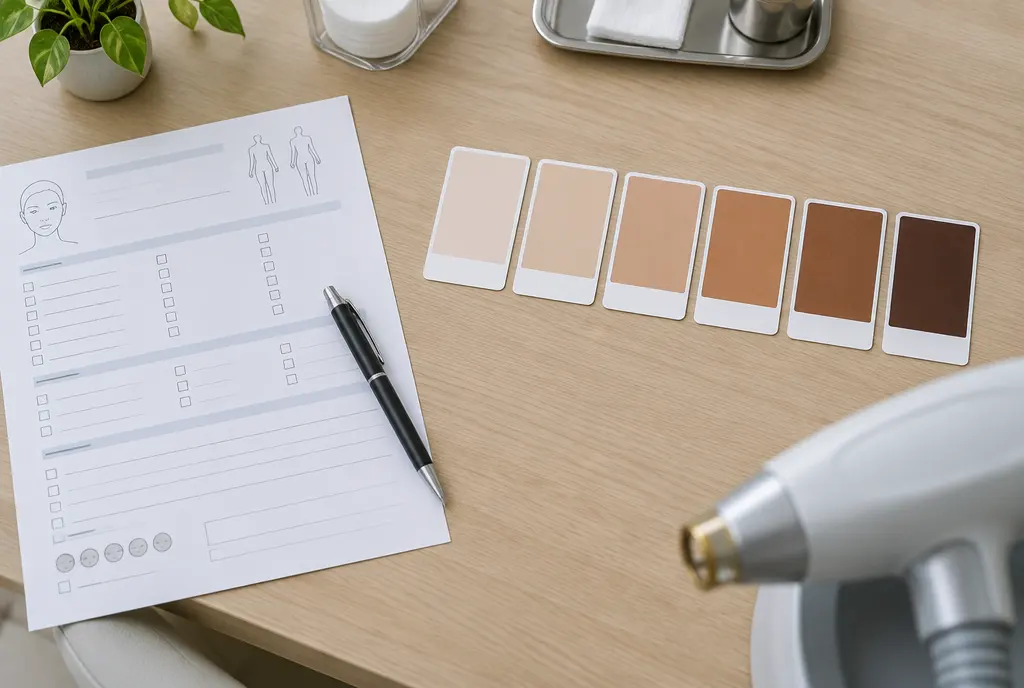
Before you sign, read the package as carefully as a rental contract:
- Compare the total, not the discount. Six sessions at €100 with 15% off is €510. Six sessions elsewhere at €80 with no discount is €480.
- Ask what happens if you need fewer sessions. If your tattoo fades faster than expected, can you get unused sessions back, or move them to another tattoo?
- Ask what happens if you need more. Is there a fixed price for extra sessions after the package?
- Read the small print on “unlimited”. Often it is limited by time, by the size of the tattoo, or to a certain number of years.
- Avoid paying a large amount far in advance to a clinic you do not know. If it closes, you may lose the money. Paying by credit card can give you more protection in some countries.
Why very cheap offers are risky
Back to Tom’s €49 deal. A professional laser for tattoo removal can cost tens of thousands of euros, needs regular servicing, and should be used by someone who has been properly trained. At very low prices something usually has to give: an older or weaker device, a rushed appointment, or an operator without much training.
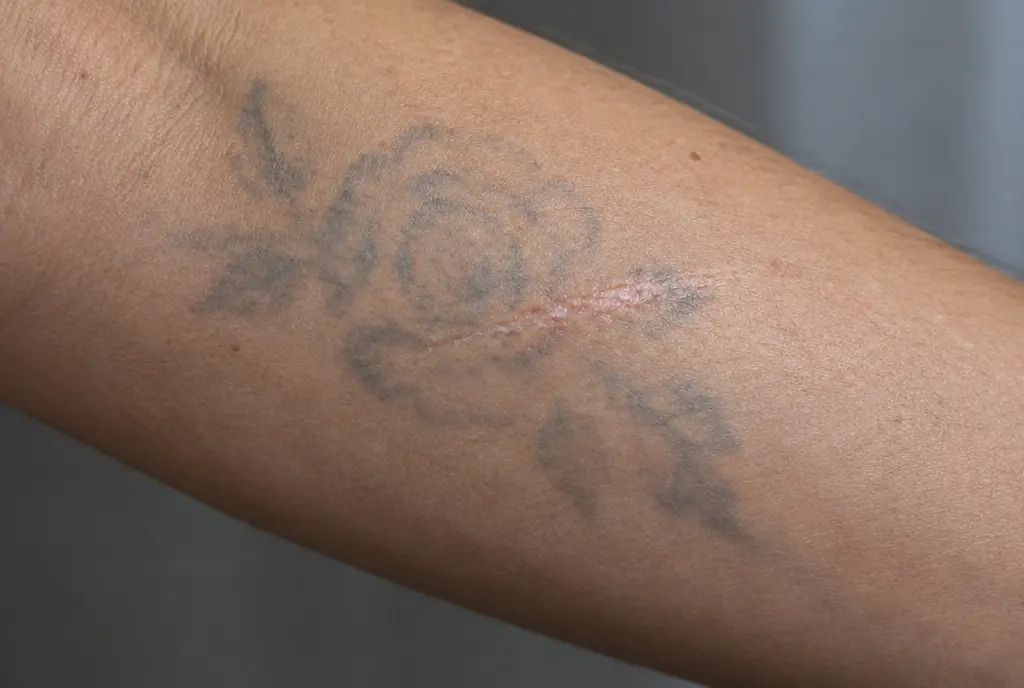
The risks are not only about wasted money:
- More sessions. A laser that is too weak, or set too low to be safe in inexperienced hands, breaks up less ink each time. Ten cheap sessions can cost more than six good ones.
- Burns, blisters and scars. Settings that are too strong, or the wrong wavelength for your skin, can burn the skin. A scar in the shape of your tattoo is much harder to fix than the tattoo itself.
- Light or dark patches. Damage to the skin’s own pigment can leave pale or dark marks that may take months to settle, and sometimes never do.
- No help when something goes wrong. A clinic that cannot recognise a complication cannot treat it either. You end up paying a doctor anyway.
The cheapest session is the one you never have to repeat.
This does not mean expensive is always good. It means a low price is only a bargain if everything behind it is in order: the type of laser, who uses it, how many sessions they honestly expect, and what they do if something goes wrong.
Ways to spend less without cutting corners
- Get two or three written quotes that include the expected number of sessions, the price per session and any extra costs.
- Ask which laser they use and why it suits your colours and skin. A clear answer is a good sign.
- Ask for a test patch on a small area if you have colours or darker skin. It shows how your skin reacts before you commit.
- Leave enough time between sessions. Coming back too early does not speed things up. It adds sessions and costs.
- Consider fading instead of full removal. If you plan a cover-up, two to four sessions to lighten the old tattoo are often enough, and much cheaper than removing it completely.
- Look after the treated skin. Good aftercare and staying out of the sun help each session do its job, which keeps the total down.
Tom, in the end, went with the middle quote. The specialist studio expected eight to ten sessions on a Q-switched laser for his black script, offered a six-session package at 15% off, and promised a fixed price for any session after that. His total came to a little over €1,000 over about eighteen months. The €49 deal, he worked out later, had a maximum size that his tattoo was already over.
Read alsoHow many laser sessions does it take to remove a tattoo? The Kirby–Desai scale with worked examplesWhat it means for you
Laser tattoo removal is not a single price but a sum: price per session times the number of sessions, plus anything extra. Size sets the first number, ink and skin set the second. A fair quote is clear about both. The cheapest-looking offer is rarely the cheapest in the end.
If you are still weighing whether to remove a tattoo, lighten it for a cover-up or keep it, it can help to see how it is likely to look in a few years anyway. With InkAge you can upload a photo of your tattoo and see how it may age over time, which can make the decision a little easier before you spend money on it.
Frequently asked questions
How much does one session of laser tattoo removal cost?
It depends mainly on size. As a rough guide in Europe, about €50–150 for a small tattoo up to 5 cm, €100–250 for a palm-sized one and €200–450 for one up to 25 cm. In the US prices are usually about twice as high. Very large pieces are often quoted individually.
What is the total cost of removing a tattoo completely?
Multiply the price per session by the number of sessions, often around 6 to 12 for a professional tattoo. Small black tattoos often end up at a few hundred euros, palm-sized ones at one to two and a half thousand, and large colourful pieces can go above five thousand.
Is picosecond laser tattoo removal worth the higher price?
Sometimes. Picosecond sessions often cost about 20–50% more. Studies suggest they work better on some colours, such as blue and green, but there is no clear proof that they need fewer sessions for ordinary black ink. For a simple black tattoo, a good Q-switched laser can be just as good value.
Are laser tattoo removal packages a good deal?
They can be. Packages of four to six sessions often bring a 10–20% discount. Compare the total price rather than the discount, ask what happens if you need fewer or more sessions, read the limits of any “unlimited” offer, and avoid paying a large sum far in advance to a clinic you do not know.
Does health insurance pay for tattoo removal?
Usually not. In most countries tattoo removal is treated as a cosmetic procedure, so you pay for it yourself. Exceptions are rare, for example some medical reasons such as a serious reaction to the ink. Check with your insurer before you start.
Sources
- Tattoo removal: how it works, process, healing and scarring – Cleveland Clinic
- The Kirby-Desai Scale: a proposed scale to assess tattoo-removal treatments – Journal of Clinical and Aesthetic Dermatology
- Comparing the efficacy and safety of laser treatments in tattoo removal: a systematic review – Journal of the American Academy of Dermatology
- Tattoo removal – German Federal Office for Radiation Protection (BfS)
- Tattoo removal: lasers outshine other methods – American Academy of Dermatology
- Understanding laser tattoo removal – University of Utah Health
Do you run a laser clinic? Show guests their own tattoo after 3, 6 and 10 sessions
Written by the InkAge editorial team from widely accepted tattoo-care practice. Figures are rules of thumb, not measurements. This is general information, not medical advice — ask your artist or a dermatologist about your own skin.
Last updated: 8 November 2026