In short
- The laser shatters pigment into smaller particles that your immune system clears slowly – that is why it takes many sessions, not one.
- Many tattoos need 6–12 sessions, 6–8 weeks apart, which often means one to two years in total.
- Black responds best; green, light blue and yellow are harder, and ghosting or lighter and darker patches of skin can remain.
- Have your own case assessed by a dermatologist or certified clinic – and if you are still before the tattoo, use the removal preview as a reality check.
In this article 12
- How does the laser work in the skin?
- Which laser, and why does it matter?
- How many sessions, and why so many?
- Stubborn colours: why green and yellow hang on
- What a session is really like
- Side effects: what to prepare for
- Darker skin tones and lasers
- Time, money and fading as a middle path
- How to choose a clinic
- A reality check before the tattoo: the InkAge laser preview
- The one thing to take away
- Frequently asked questions
A white-walled treatment room, protective goggles in your hand, and on your arm a name you thought was a forever decision seven years ago. The practitioner asks if you are ready, then comes a series of quick, snapping pulses, and for a moment your skin turns frosty white. The whole thing takes half a minute. On the way home you think: is that it? No – that was only the first step of a journey that will likely take a good year and a half.
This article is about what really happens during laser tattoo removal – in your skin, in the clinic and in your calendar. We will look at how the laser works, why it takes so many sessions, why some colours are stubborn, which side effects to prepare for and how to choose a trustworthy clinic. At the end we will also talk about how to use all of this before you get a tattoo, so that ideally you never have to try it in practice.
How does the laser work in the skin?
Tattoo ink sits in the middle layer of the skin, the dermis. The pigment particles are too large for the body to simply carry away, which is why they stay put for decades. Some of them are swallowed and “held” by the skin’s scavenger cells – which is also why a tattoo fades slowly but never disappears on its own.
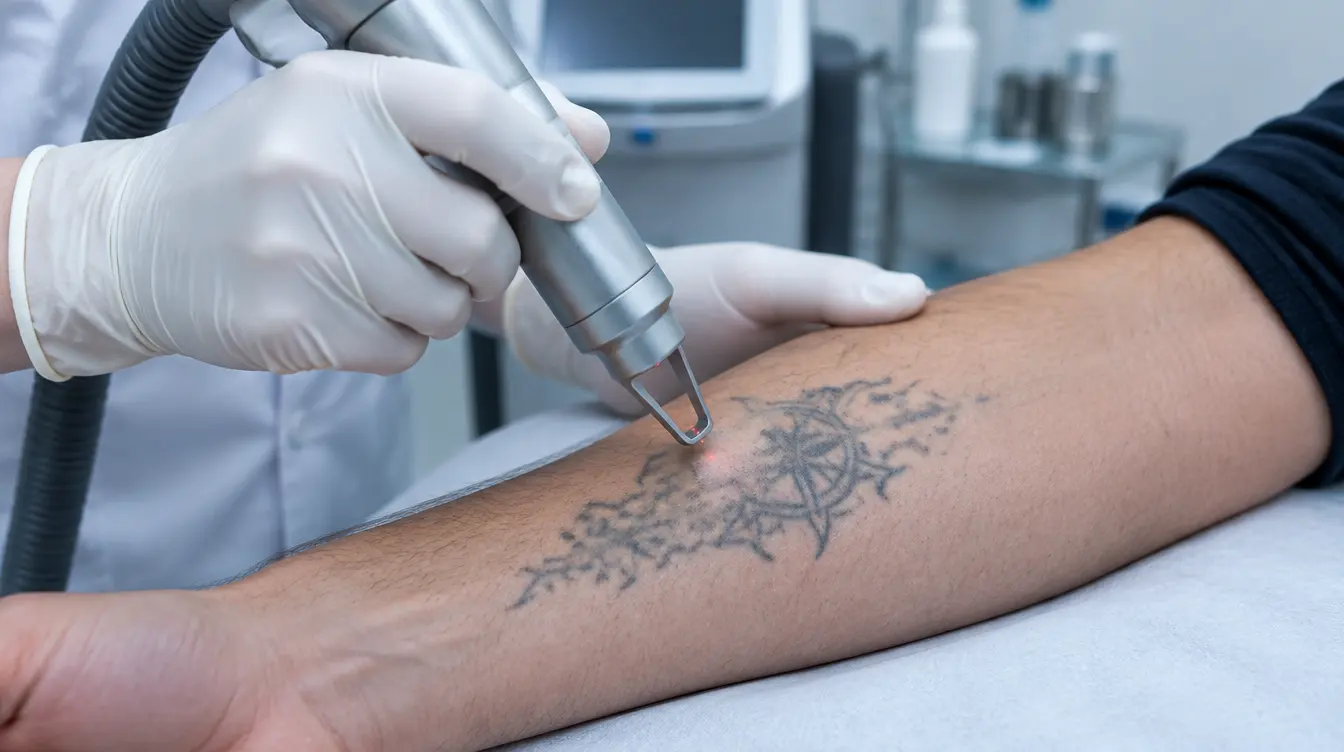
A tattoo removal laser sends extremely short, high-energy pulses of light into the skin. The pigment absorbs that energy, heats up rapidly and breaks into smaller particles. Those smaller pieces can then be cleared by the immune system through the lymphatic system. The method tries to spare the surrounding tissue, because the light is absorbed mainly by the ink, not by the skin.
This leads to the most important fact many people do not know: the laser does not “wipe off” a tattoo. It only starts a process, and most of that process happens in your own body in the weeks after the session. The few minutes in the clinic are the spark; the real work comes afterwards.
The white “frost” you see during treatment is also a sign of that sudden heat: the skin’s surface turns white for a few minutes, then its colour returns. It does not mean the ink is gone, only that the energy reached its target. Each session shatters part of the pigment while the rest stays in place for the next round – which is why the design fades gradually, layer by layer, not overnight.
Which laser, and why does it matter?
Two types are typically used for tattoo removal. Q-switched lasers work with nanosecond pulses and have been the standard for decades. Picosecond lasers deliver even shorter pulses, which in some cases may shatter pigment more efficiently. How much difference that makes for your tattoo cannot be said in general, and neither technology can promise miracles.
The wavelength matters at least as much. Every colour absorbs a different kind of light well: what works brilliantly on black barely touches green. That is why a well-equipped clinic has several wavelengths available, and the practitioner adjusts the settings to the colours in your tattoo. If a place works with only one wavelength, ask what they can do with the non-black parts of a colourful piece.
How many sessions, and why so many?
Many tattoos need 6–12 sessions, typically with 6–8 weeks between them. That gap is not a matter of convenience: it is the time the skin needs to heal and the immune system needs to clear part of the shattered pigment. Repeating sessions too often does not speed up clearance, but it does raise the risk of skin damage. Added up, that often means one to two years.
How many you will need depends on several factors together:
- the amount and density of ink: professional, saturated, solid black work usually takes longer than an older, lighter amateur tattoo;
- the colours: the more hard-to-treat colours, the longer the road;
- the location: areas further from the heart, such as ankles or fingers, often clear more slowly than the torso;
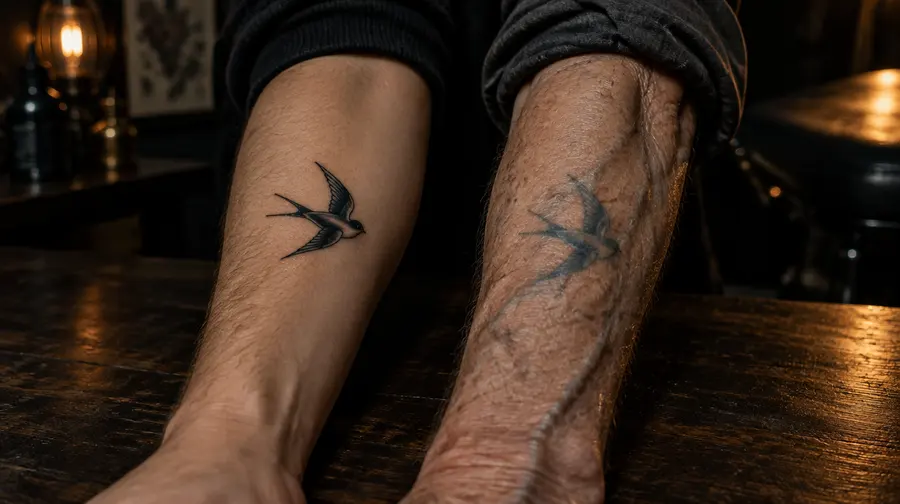
- the age of the tattoo: older tattoos have often already faded somewhat on their own;
- skin tone and general health: smoking or a weaker immune response can slow the process;
- existing scars or layered cover-ups: these bring extra challenges.
Some clinics use scoring systems – such as the Kirby–Desai scale described in the medical literature – to estimate the number of sessions in advance. These are useful starting points, not predictions. An honest practitioner gives you a range, not an exact number.
What to expect from session to session
Many people find that the change is dramatic after the first few sessions, but the pace slows later on. It is easy to lose heart at that point, yet it is completely natural: the remaining pigment often sits deeper or is made of harder-to-treat colours. It also happens that a tattoo looks almost unchanged for a few weeks after a session, and then is lighter by the next appointment after all. Patience really is part of the process here.
Laser removal is not an afternoon – it is a season, often two.
Stubborn colours: why green and yellow hang on
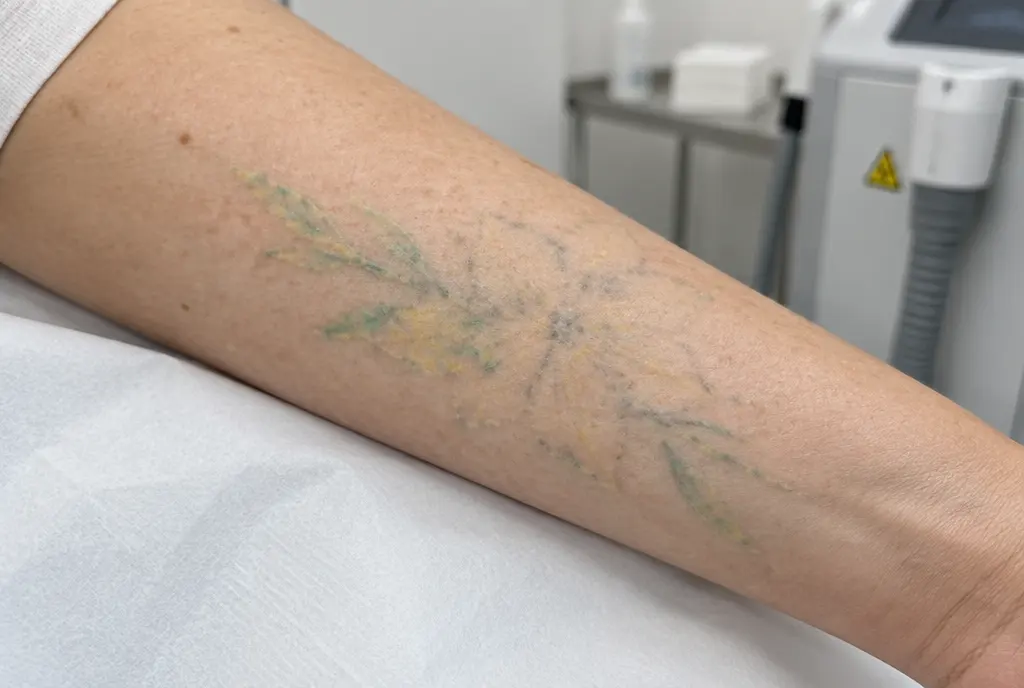
Black responds best, because it absorbs almost every wavelength well. Dark blue and red are also usually treatable with the right settings. Green, light blue and yellow, however, can be genuinely difficult: they need different wavelengths, and even then they often fade more slowly than the black parts.
White and very light, skin-toned shades are a special case. Some of these pigments can darken under the laser, which is why practitioners often start with a small test spot. If your tattoo has a lot of pastels or white highlights, make sure to discuss this in advance.
In practice it is common for the black outline of a colour tattoo to have almost vanished while some of the fill colours are still clearly visible. That is not failure, it is physics – it is just worth factoring in when you think about the number of sessions and the timeline.
Where the ink came from matters too. Nobody knows the exact composition of an old tattoo made at home or with unknown ink, so its reaction is less predictable. Sometimes it fades more easily, sometimes it is surprisingly stubborn. If you know where and when your tattoo was done, tell the practitioner – every piece of information helps in choosing the settings.
What a session is really like
Before
The first visit is usually a consultation: the practitioner looks at the tattoo and your skin type and asks about your medications, skin conditions and tendency to scar. They take a photo so the change can be compared later. In the weeks before treatment, it is wise to protect the area from the sun and tanning beds, because tanned skin carries a higher risk.
During
Most people describe it as a rubber band snapping against the skin over and over, with a little burning sensation. Clinics often use cooling or numbing cream. Treating a small tattoo takes a few minutes, a larger one longer. Afterwards the skin may turn white, red and swollen – that is part of the expected reaction.
After
Over the next few days the area may be tender, and blisters and scabs can appear. The most important thing is to follow your clinic’s instructions. As general guidance:
- Keep the area clean and dry, and use the cream or dressing the clinic recommends.
- Don’t pop blisters or pick at scabs – let them come off on their own.
- Avoid sun, tanning beds, swimming pools and saunas until the skin has fully healed.
- Even after healing, use a high-SPF sunscreen on the area.
- If you notice unusual pain, pus or fever, contact a doctor or the clinic.
Side effects: what to prepare for
Laser removal is a medical procedure, and it carries risks. Most side effects are temporary, but it is worth knowing them honestly before you start:
- redness, swelling, tenderness – almost always in the days after a session;
- blistering and scabbing – common, usually settling within a few days;
- hypopigmentation – the skin becomes lighter in the treated area;
- hyperpigmentation – the skin becomes darker in the treated area;
- ghosting – a faint outline of the design may remain even after most of the ink is gone;
- rarely, scarring or a change in skin texture – mostly with wrong settings, sessions too close together or poor aftercare.
Pigment changes often fade over months, but they do not always disappear completely. If you have any skin condition, a tendency to raised scars (keloids), or you take medication that makes you sensitive to light, be sure to mention it at the consultation. In that case it is best to let a dermatologist decide whether it is worth starting at all.
Less often, the shattered pigment can trigger an allergic-type skin reaction; this has been described mainly with certain coloured inks, such as red. If your tattoo has itched, swollen or developed a rash before, that is especially important information for the consultation. Judging situations like these is a job for a doctor.
Darker skin tones and lasers
On darker skin, the skin’s own pigment, melanin, can also absorb part of the laser light. That raises the risk of pigment changes, and the practitioner has to work with more cautious settings, often a longer wavelength. This frequently means more sessions and a slower process.
It does not mean tattoos cannot be removed from darker skin – only that experience matters even more here. Ask the clinic how much experience they have with your skin type, and ask for a test spot before they treat the whole tattoo.
Time, money and fading as a middle path
The price of a session varies a lot: it depends on the size of the tattoo, the colours, the device, the clinic and even the city. That is why we do not give a specific figure here. What is worth knowing is that the total cost multiplies with the number of sessions, and since only a range can be estimated in advance, the final total will be a range too. Ask whether they offer package prices and what happens if you need more sessions than planned.
Full removal is not always the goal. Many people ask only for fading with a few sessions, so that a new tattoo – a cover-up – can hide the old one more easily. This can be a shorter and cheaper path, and the artist can work much more freely over a faded base. If you are considering this, talk to both the artist and the clinic before you begin.
Timing is worth planning too. Because treated skin must be protected from the sun, many people start their series in autumn or winter so that beach season does not fall into the most sensitive period. If you are preparing for a wedding, a holiday or an important event, factor in that the area can be red, swollen and scabbed in the days after a session.

How to choose a clinic
Laser removal is not a cosmetic triviality, so choosing where to go may be the most important decision. A few questions worth asking:
- Who performs the treatment, and what qualifications do they have? Is there a doctor, ideally a dermatologist, involved?
- What type of laser and which wavelengths do they use?
- Do they hold an in-person consultation, and do they assess your skin type, medications and medical history?
- Do they give an estimated range for the number of sessions, or promise a fixed number? The latter is a warning sign.
- Do they honestly explain possible side effects, including ghosting and pigment changes?
- Do you get written aftercare instructions, and can you reach them if something goes wrong?
If someone promises a “guaranteed traceless” result in one or two sessions, that says more about their marketing than about their expertise. An honest clinic speaks carefully. That is not uncertainty – it is professional integrity.
A reality check before the tattoo: the InkAge laser preview
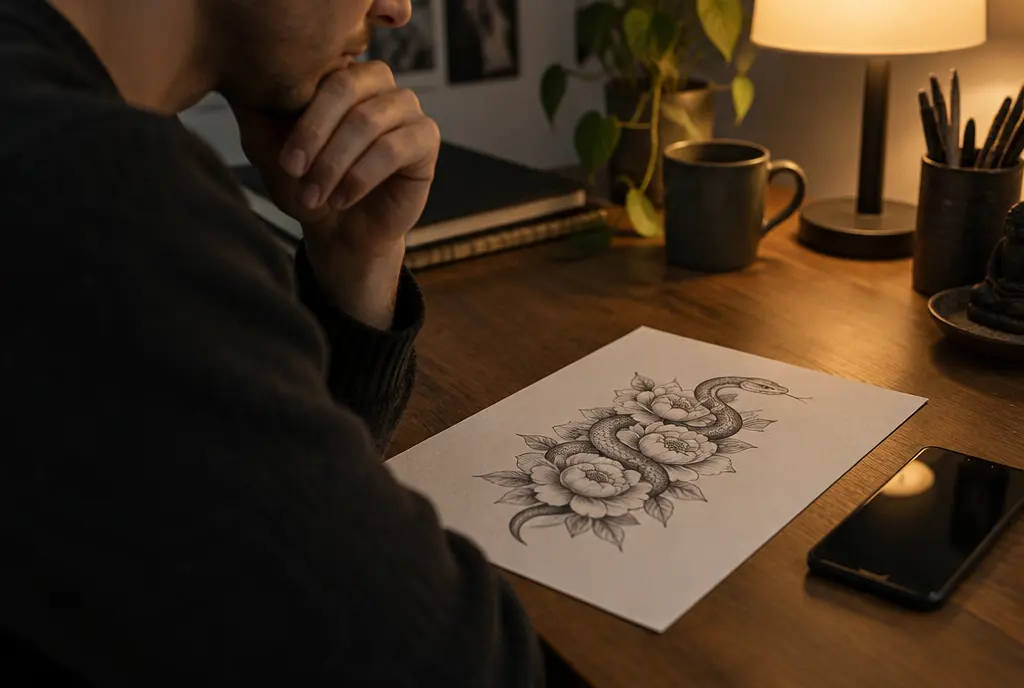
Most people only start thinking about removal once they already regret a tattoo. Yet the best moment to think about it is before the tattoo. Not because anything will go wrong, but because the question “what if I don’t like it one day?” helps you make better decisions about size, placement and style.
In InkAge you can see on your own skin how your design would look fresh and after 1, 10, 30 and 50 years – and you can also see how it would look after 3, 6 and 10 laser sessions. This is not a medical forecast but an illustration, yet it tells you a lot. If you see that a large, solid, colourful design is still strongly visible after ten sessions, that is a good sign to think carefully about whether you really want that size and that spot.
You learn the most when you try several versions. Put the same design side by side at a smaller size, with simpler lines, in black only or on another part of the body, and see how the picture changes after 3, 6 and 10 sessions. And if you are curious what others think, your friends can vote on the versions too – sometimes an outside eye spots the timeless choice faster.
It is worth looking at the laser preview together with the longevity score. A few practical questions to ask yourself:
- If I ever wanted it gone, would it be in a place I can cover?
- Could the same effect be achieved at a smaller size or with fewer colours?
- Would a black-and-grey version not only age better, but also be easier to fade?
If you are unsure, choose a placement you can cover and a size you will not regret. That is not pessimism, it is good planning. And for questions about your own skin and health, always turn to a dermatologist or a certified clinic.
The one thing to take away
Laser removal is a real option, but it is slow, demands a lot of patience, is not always complete, and at its best is a joint effort between a careful professional and your own immune system.
If you are already thinking about removal, don’t rush: see a dermatologist or a certified clinic, ask for an honest estimate and plan for the long term. And if you are still before the tattoo, the best thing you can do is look at the decision not only through today’s eyes, but through the eyes of the person you will be in ten or twenty years.
The cheapest and fastest removal is the one you never need – so before you decide, look at what the future would bring.
Frequently asked questions
Does laser removal hurt?
Most people compare it to a rubber band snapping on the skin, with a short burning sensation. Clinics often use cooling or numbing cream, and a session on a small tattoo lasts only a few minutes. The area can stay tender for a few days afterwards.
Can every tattoo be removed completely?
Not always. Some colours and very dense ink resist, and a faint ghost or lighter and darker patches of skin may remain. A dermatologist or certified clinic can assess your own case.
Why do I have to wait 6–8 weeks between sessions?
The skin needs time to heal, and the immune system needs time to clear the shattered pigment. Treating again too soon does not speed up removal, but it does increase the risk of skin damage. Your clinic may recommend a different interval for your skin.
Is laser removal riskier on darker skin?
The risk of lighter or darker patches is higher, because melanin can also absorb laser light. An experienced practitioner adjusts the settings and often starts with a test spot. It usually means more patience, not that removal is impossible.
Can I just fade a tattoo for a cover-up?
Yes, many people do exactly that. A few sessions can lighten the old design enough for an artist to work over it more freely. Ask your artist how much fading they need before you start.
Written by the InkAge editorial team from widely accepted tattoo-care practice. Figures are rules of thumb, not measurements. This is general information, not medical advice — ask your artist or a dermatologist about your own skin.
Last updated: 13 October 2026