In short
- Ink sits in the dermis, where immune cells capture and re-release it for decades – that is why every tattoo slowly changes.
- Lines spread roughly 0.1 mm per decade; fine lines closer than 1 mm can merge within 10–15 years.
- Black is the most stable; yellow, white and pastel shades fade first, especially in the sun.
- Strong outlines, a generous size, a protected spot, SPF 50 and a touch-up every 8–10 years make the biggest difference.
In this article 12
- Where does the ink actually go?
- Your immune system never gives up
- Why do lines spread?
- Why do colours fade at different rates?
- The sun: a tattoo’s worst enemy
- Your skin ages too – and takes the design with it
- Timeline: how an average tattoo changes
- What speeds ageing up, and what slows it down?
- How to preview it on your own skin
- Touch-ups, reworks and removal
- The one thing to take away
- Frequently asked questions
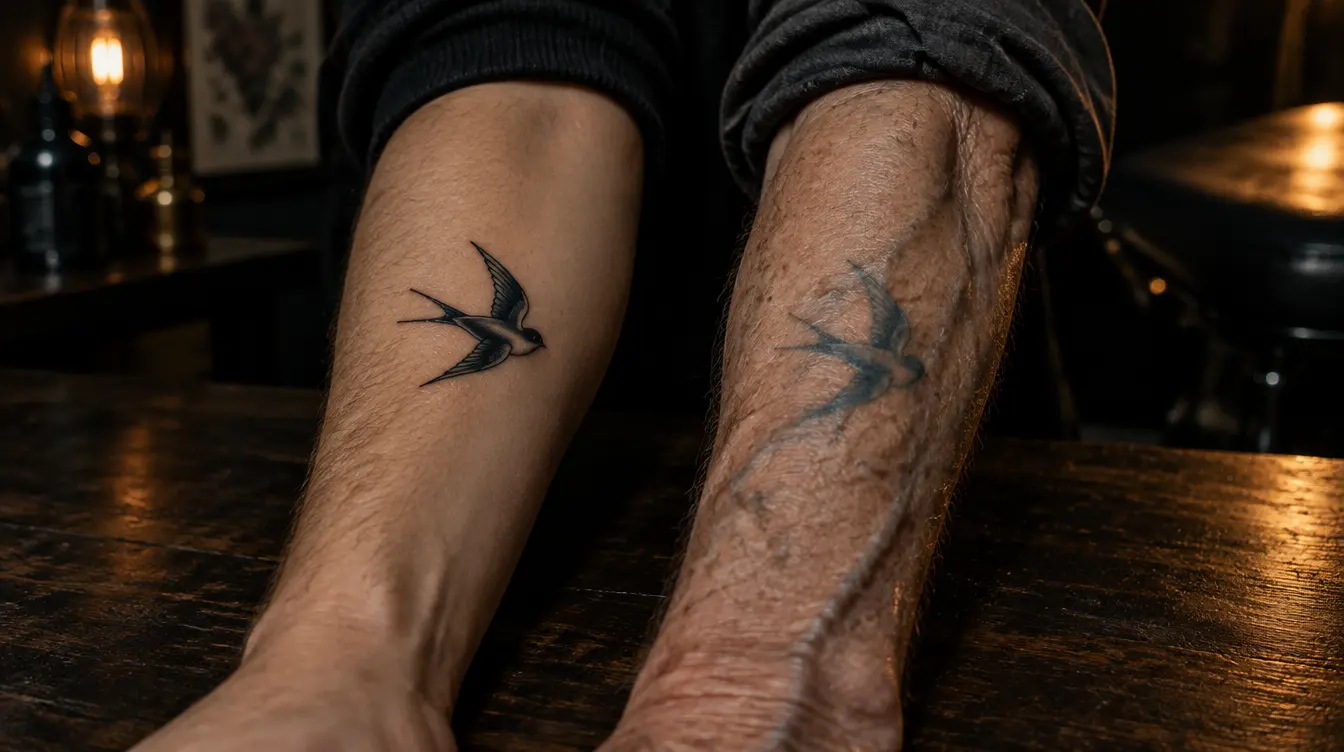
At a summer family lunch your uncle rolls up his sleeve, and there it is: the old anchor on his outer forearm. He got it thirty or forty years ago, somewhere in a port town or in a friend’s kitchen. Today it is more of a bluish-grey patch than a drawing: the lines of the rope have merged, the letters underneath are barely readable, and the edges are soft, as if someone had smudged them. He laughs about it, but you catch yourself glancing at your own arm and wondering: will mine look like that?
The short answer: to some extent, yes – every tattoo changes. The longer answer is far more reassuring, because how much and how fast is largely down to you and your artist. In this guide we walk through what happens to the ink in your skin from day one to year fifty: where the pigment goes, why your immune system keeps trying to clear it, why lines spread, why yellow fades before black, and what your own ageing skin does to all of it. At the end we show you how to preview it all on your own photo.
Where does the ink actually go?
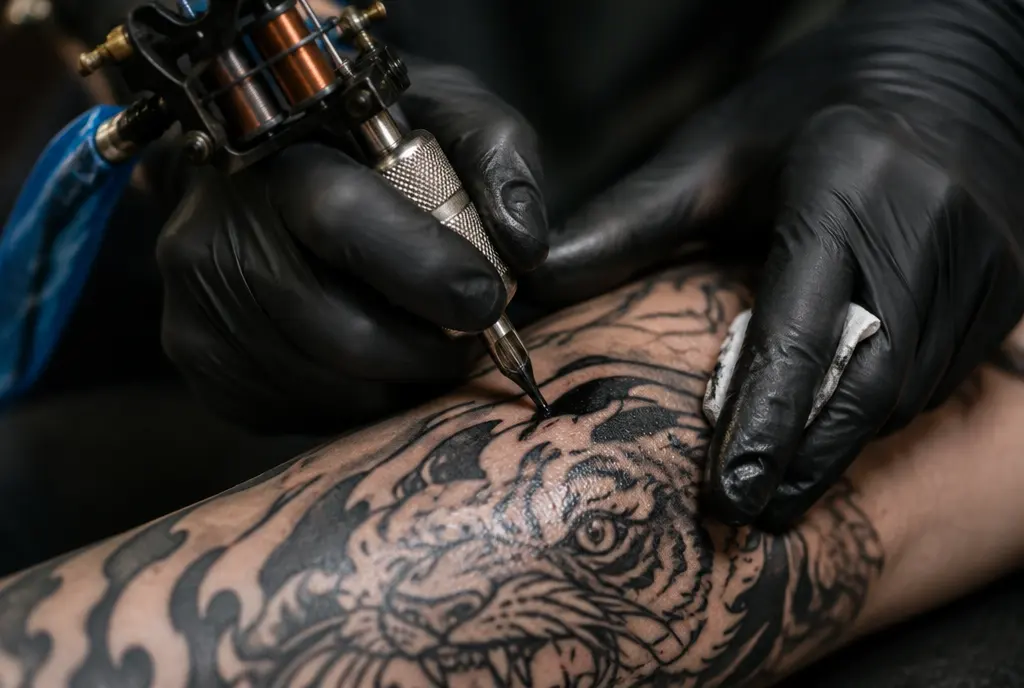
Two layers of your skin matter here. The outermost is the epidermis, which renews itself constantly: dead cells flake off, new ones push up from below, and the cycle takes roughly a month – more slowly as you get older. If ink were placed there, it would simply wear away within weeks. That is why the tattoo needle delivers pigment beneath it, into the dermis, typically about 1–2 millimetres deep.
The dermis is a different world. It holds collagen and elastic fibres, blood vessels, nerve endings and hair follicles. This layer does not shed, which is why a tattoo can last for decades. The pigment particles in tattoo ink are also too large for the body to carry away easily – one of the keys to their permanence.
Exactly how deep the ink goes matters a lot. Too shallow, and it falls out in patches as the skin heals. Too deep, and the pigment can spread into the layer beneath, leaving a bluish, blurry halo around the line – known in the trade as a blowout. That is why a good artist doesn’t just draw well, but also has a precise feel for the skin’s resistance.
Your immune system never gives up
Your body treats ink as a foreign substance and tries to get rid of it. In the days after you get tattooed, immune cells flood the area and carry some of the pigment away – that is why a fresh tattoo weeps a little ink, and why the healed piece looks slightly lighter than on day one. Most of the remaining pigment is swallowed and held by scavenger cells living in the dermis, called macrophages.
For a long time it was thought that these cells simply hold on to the pigment for decades. A 2018 mouse study published in the Journal of Experimental Medicine (Baranska and colleagues) painted a more nuanced picture: when a pigment-filled macrophage dies, the ink is released, and new macrophages nearby swallow it again. A tattoo, then, is not a static drawing but the result of a slow relay passed from cell to cell. Although the research was done in mice, it helps explain why ink is so stubborn, and why laser removal takes several sessions.
This cycle has a consequence: with every “hand-over”, a little pigment can shift, and a little can leave through the lymphatic system – it has long been known that ink can be found in the lymph nodes of tattooed people. Over a single year you can’t see any of this. Over decades, though, it adds up, and that is where the soft, slightly spread outline of old tattoos comes from.
A tattoo is not a finished drawing in your skin – it is a slow process that lasts fifty years.

Why do lines spread?
Artists often describe the slow drift of pigment with a simple rule of thumb: roughly a tenth of a millimetre of spread per decade. It is not a precise scientific measurement but an estimate from experience, and it varies with skin, body area and ink – yet it is surprisingly useful for planning.
On a 2-millimetre line this change is barely noticeable: over thirty years it might widen to a little over 2.5 millimetres and still be a strong, readable line. Details are a different story. If there is only a one-millimetre gap between two thin lines, and both spread outwards, the gap closes from both sides. Fine lines closer than 1 mm often merge within 10–15 years, and what used to be two separate lines becomes a single blurred band.
What does this mean in practice?
- The inner spaces of small letters (the middle of an “e”, “a” or “o”) fill in first, so tiny script can become illegible.
- Dense dotwork and fine shading melt into a uniform grey area.
- The details of faces, eyes and tiny petals get lost, while the outline of the shape may survive.
- Bold, airy designs – a classic swallow or a larger rose, for example – are still recognisable after decades.
That is why experienced artists say you should design not for today, but for how it will look in twenty or thirty years. If a detail only works in the fresh photo, it isn’t really part of the final design – it’s a short-lived bonus.
Why do colours fade at different rates?
Not all pigments are equal. Black ink is usually carbon-based; its particles are stable and resist light well – which is why black is the longest-lasting colour, and why blackwork and classic traditional styles age so gracefully. Red and blue generally hold up fairly well, though some shades dull over time.
Yellow, orange, white and pastel shades fade fastest. These pigments tend to be more sensitive to UV light, and light shades offer less contrast against the skin to begin with, so the same loss is more visible. A bright yellow sunflower can turn a pale cream within a few years, while its black outline stays almost unchanged.
A special word on white ink
White ink is especially unpredictable. Fresh, it gives beautiful, delicate highlights, but it often turns yellowish or skin-coloured within a few years, or almost disappears. If you want white details, treat them as temporary decoration, not as the backbone of the design.
This leads to one of the most important rules for colour tattoos: the black outline is what holds the shape. As colours fade, a strong outline keeps the image together. In outline-free, watercolour-style designs, however, the shape itself can dissolve as the colours blur.
The sun: a tattoo’s worst enemy
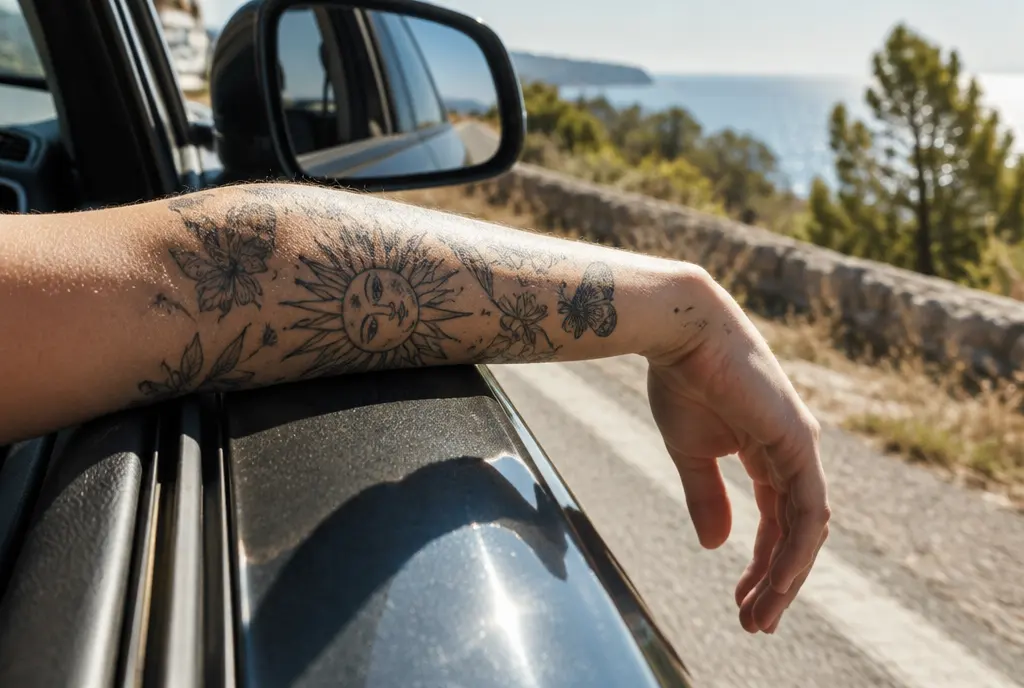
If we had to name the single thing that harms tattoos most, it would be sunlight. UV radiation breaks down pigment and ages the skin at the same time: it weakens collagen and causes spots and wrinkles. A tattoo on a regularly sun-exposed outer forearm can look years older than the same design on the inside of the upper arm.
The most vulnerable time is healing. A fresh tattoo is an open wound and you shouldn’t put sunscreen on it, so simply avoid the sun: cover it with clothing, stay in the shade and skip the tanning bed. Sunburn at this stage doesn’t just hurt – it can also compromise healing and how well the ink settles.
Once healed, sunscreen becomes your best friend. Whenever the tattoo is exposed, use a broad-spectrum SPF 50, and reapply every few hours and after swimming. It is the same habit that protects your skin’s health – the tattoo is just a good reminder.
Your skin ages too – and takes the design with it
Even if the ink didn’t move a hair’s breadth, your tattoo would still change, because the skin it lives in changes. With age, collagen and elastin decrease, skin becomes thinner and less elastic, wrinkles appear and sun damage can leave pigment spots. The tattoo follows all of this: it becomes looser and softer, and where the skin creases, so does the design.
Changes in weight, building muscle or pregnancy can also stretch the skin. Usually the design stretches evenly, so most tattoos keep their look – strict geometric shapes, straight lines and perfect circles, however, can distort more visibly.
Not every body part ages the same way
- Ages gently: inner arm, upper arm, shoulder, upper back, ribs, thigh and calf. They are mostly covered, see little friction and the skin stays fairly stable.
- Ages faster: back of the hand, fingers, feet, elbows, knees and the outer forearm. These spots get a lot of friction, washing, bending or sun.
This isn’t a list of forbidden zones. A finger tattoo can be beautiful too – just expect it to need touch-ups more often, and its fifty-year version to look much further from today’s than a design on your shoulder.
Timeline: how an average tattoo changes
Every skin and every tattoo is different, but the timeline below shows what you can expect from a well-made, medium-sized design with a black outline that doesn’t get too much sun.
After 1 year
Healing is long finished. The design is a little softer and lighter than on day one, because the surface ink has been shed and a fresh layer of epidermis has grown over it. This is completely normal: in fact, this is your tattoo’s true, healed face.
After 10 years
Bold lines look almost the same, but fine details begin to soften. Light colours – especially yellow and white – may be noticeably paler. If the piece sits somewhere sunny, contrast drops too. Many people get their first touch-up around this time.
After 30 years
Lines are visibly wider and close details may merge. The skin itself is thinner, which makes the design slightly looser. A well-planned, airy design is still clearly recognisable; a tiny, dense one may become patchy.
After 50 years
The tattoo speaks mostly through its shape and silhouette. Black outlines hold the image, most colours have mellowed, and the ageing of the skin leaves its mark too. That isn’t necessarily ugly – many older people’s tattoos are genuinely beautiful, because the design was made for time from the start.
What speeds ageing up, and what slows it down?
Putting it all together, two clear groups emerge. One holds the factors to think about on the day you get tattooed; the other holds the ones that stay with you for life.
What speeds it up
- regular sun without protection, especially sunburn
- friction and frequent washing (hands, fingers, feet)
- very thin lines placed too close together
- light colours without an outline, white and pastel ink
- poor healing: picking scabs, infection, swimming or the beach too early
- habits that speed up skin ageing in general, such as smoking
What slows it down
- a strong, sufficiently bold black outline
- a size that gives details room (at least 1–2 mm between lines)
- a protected body area
- consistent SPF 50 sun protection
- careful aftercare in the first weeks, following your artist’s instructions
- an experienced artist who knows skin well
Notice that most of the list is about decisions, not luck. You can’t stop a tattoo from ageing, but you largely decide how it will age.
How to preview it on your own skin
Reading about all this is one thing; seeing it on your own arm is something else. That is exactly what InkAge was built for: so you don’t have to guess your future from a stranger’s old photo, but can see the likely changes on your own skin, with your own design.
- Upload a photo of the body part where you plan the tattoo – in natural light, sharp, ideally straight on.
- Place the design: upload your artwork, then adjust its size and position the way you would in real life.
- Look at the timeline: next to the fresh version, see the likely result after 1, 10, 30 and 50 years. On the 10- and 30-year images especially, watch where details start to merge.
- Check the ink longevity score, which shows from 0 to 100 how likely the design is to age well at that size and in that spot.
- Try “Make it last”, which redraws the design in a more durable version – with stronger key lines and airier details – so you can compare the two.
The preview is an estimate, not a prophecy: the real result also depends on your skin, your artist’s hand and your lifestyle. But it is excellent for spotting, before you book, when a detail is too small, when a slightly bigger size would help, or when another body part would serve the design better. You can take the result to your artist as a PDF, and your friends can vote on which version they like more.
Touch-ups, reworks and removal
A tattoo’s ageing isn’t a one-way street. The simplest option is a touch-up: the artist retraces faded lines and refreshes the colours. For many designs it is worth planning one every 8–10 years, and more often in fast-wearing spots such as hands and fingers.
If a design has blurred so much that a touch-up no longer helps, a rework or cover-up may be an option: a larger, darker new design that absorbs the old one. This takes a lot of creativity, and how dark the old ink is largely determines what can go over it.
As a last resort there is laser removal, which breaks pigment into tiny fragments so the immune system can clear them more easily. It usually takes several sessions, some colours are harder to remove than black, and the skin isn’t always left without a trace. InkAge’s laser preview helps you picture what to expect, but always discuss removal with a dermatologist or a qualified specialist.
The one thing to take away
If you remember only one thing from this article, make it this: don’t design for the fresh photo – design for year thirty. The ink will move, colours will fade and your skin will age – that is the nature of a tattoo, not a flaw.
The good news is that a tattoo with a strong outline, a sensible size, a protected spot and regular sunscreen will still look good decades from now. Not the same as on day one, but the way something that ages well looks: softer, yet yours, and recognisably what you meant it to be.
Frequently asked questions
Does every tattoo blur eventually?
Every tattoo softens a little, because pigment slowly drifts in the skin over decades. Bold lines with enough space between them, however, stay readable for decades. Very fine, tightly packed details blur first.
Can I slow it down?
Yes. Consistent sun protection (SPF 50), careful aftercare in the first weeks and a sensible, airy size make the biggest difference. A protected body area and a strong black outline help a lot too.
Why does a healed tattoo look lighter than a fresh one?
During healing some of the ink near the surface is shed, and a new layer of epidermis grows over the design like a thin veil. This is completely normal and doesn’t mean anything went wrong. If a line healed patchily, your artist can usually fix it after a few weeks.
Which colour lasts longest?
Black, because carbon-based pigment is stable and resists light well. Red and blue usually hold up fairly well, while yellow, orange, white and pastels fade first. In a colour piece, a strong black outline therefore helps a lot.
Is it a problem that some ink reaches the lymph nodes?
It has long been known that pigment can be found in the lymph nodes of tattooed people, and for most people it causes no symptoms. Researchers are still studying the long-term effects. If you have a health question or concern, talk to a dermatologist.
Written by the InkAge editorial team from widely accepted tattoo-care practice. Figures are rules of thumb, not measurements. This is general information, not medical advice — ask your artist or a dermatologist about your own skin.
Last updated: 12 October 2026