In short
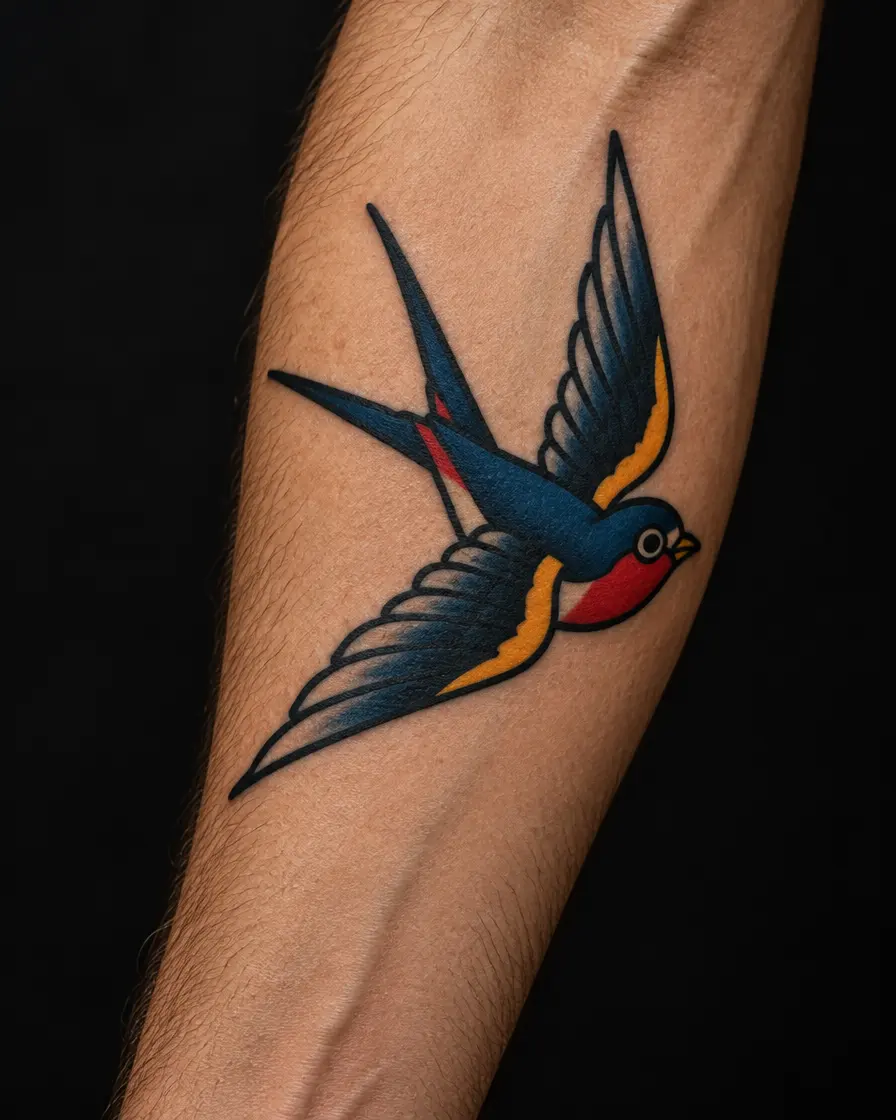
- American traditional ages better than almost any other style because it was built for it: thick black outlines, a small palette, solid fills and simple, readable shapes.
- Over decades every tattoo softens. Lines spread a little and colours mellow, but a bold design has enough margin that it still reads clearly at 30 years and beyond.
- Black, red and green usually hold best; yellow and white fade first. Sun exposure is one of the main things that speeds that up.
- Size and placement matter as much as style: shrunk-down flash and sun-exposed spots like hands and feet age fastest.
In this article 12
- The short answer
- What makes a tattoo American traditional
- A short history: sailors, flash and Hotel Street
- Why bold will hold
- What 10, 20 and 30 years really do
- Colours that last and colours that fade
- Where American traditional ages best
- The most common mistake: shrinking the flash
- Touch-ups and refreshing an old piece
- How to help yours age like the old ones
- What it means for you
- Frequently asked questions
Nora found the photo in a shoebox at her grandmother’s flat. Her grandfather, about twenty-two, sleeves rolled up on a harbour wall, and on his forearm a fresh dagger through a rose: hard black outline, a red flower, two green leaves, a yellow hilt. She knew that tattoo. She had seen it every summer of her childhood on the same forearm, by then wrinkled and freckled, the yellow almost gone, the red a little darker, the black lines a touch wider. And yet it was still, unmistakably, a dagger through a rose.
That is what people are really looking for when they search for American traditional tattoo before and after. Not a dramatic transformation, but the opposite: a style that changes surprisingly little in a lifetime. This guide explains why, what the years actually do to it, which colours last, and how to give your own piece the best chance of looking like Nora’s grandfather’s fifty years on.
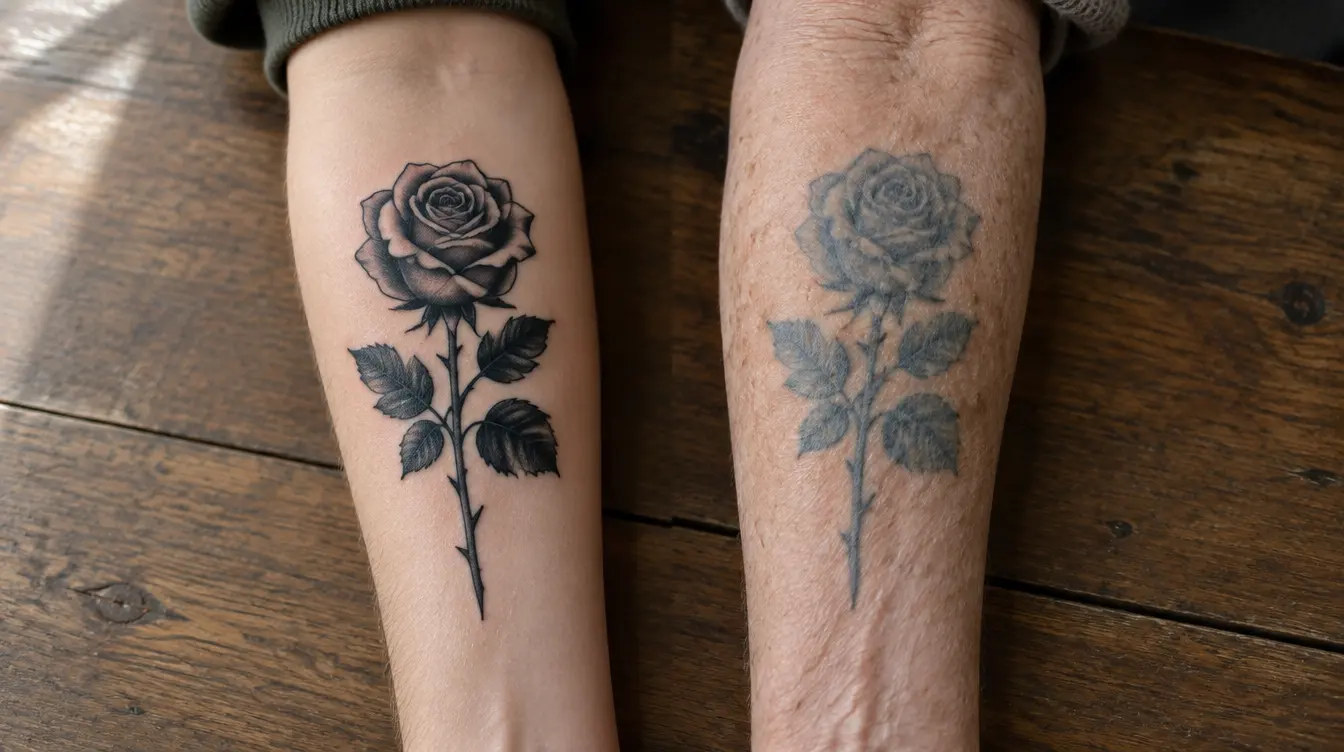
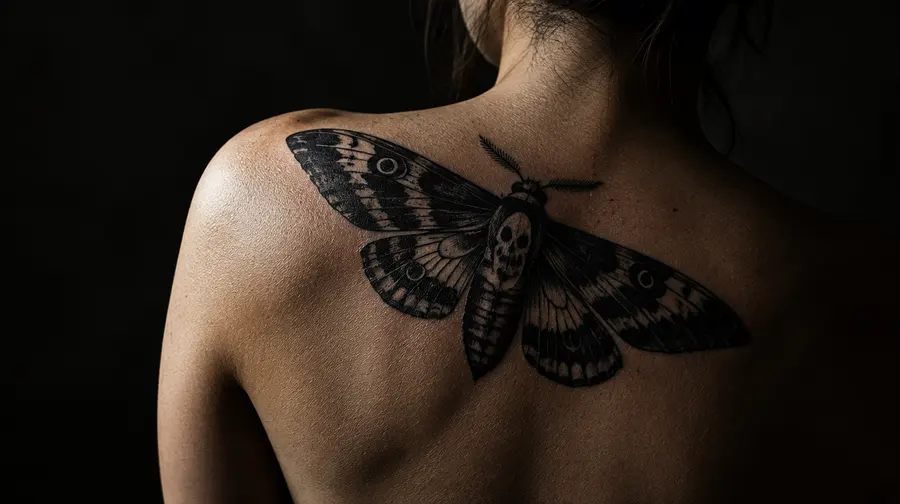
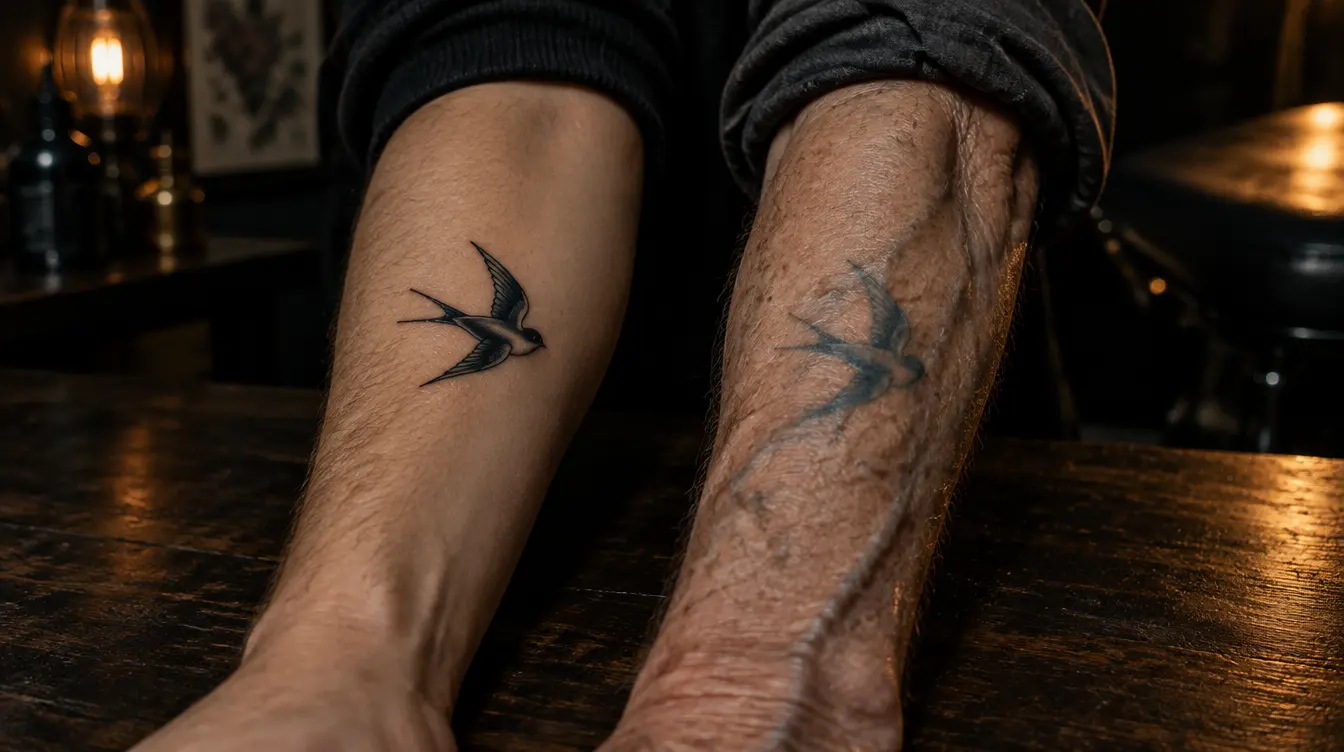
> A note on the pictures: the images in this article are illustrations made to show typical changes. They are not photos of real people or real tattoos.
The short answer
American traditional ages better than almost any other tattoo style, because it was designed to. Thick black outlines, a limited palette, solid colour fills and bold, simple shapes leave a lot of room for the slow changes every tattoo goes through. After ten years a well-done piece usually looks almost the same. After thirty, the lines are a little softer and the colours more mellow, but the image still reads at a glance.
It is not magic, and it is not immune to time. Sun, poor technique, a design shrunk too small or a spot that rubs and stretches can age a traditional tattoo badly too. But if you start with a solid piece and look after it, this is the style that most reliably still looks like itself decades later.
Read alsoHow tattoos age: what really happens to ink over 50 yearsWhat makes a tattoo American traditional
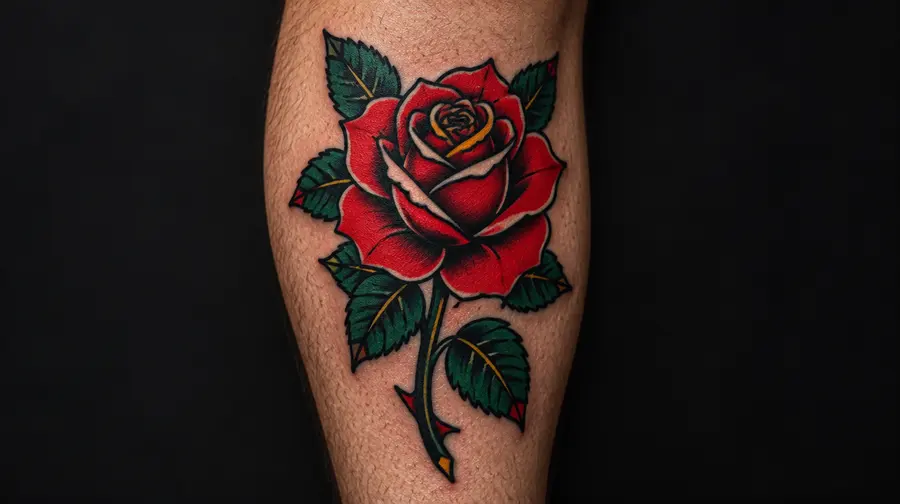
American traditional, also called old school or classic Americana, is the style most people picture when they think of a sailor’s tattoo. You can recognise it by a handful of features:
- Heavy black outlines. The outline does most of the work. It holds the colour in place and gives the design its shape.
- A small palette. Black, red, green and yellow form the core, often with some blue, brown or purple. Colours are laid in solid, not blended into soft gradients.
- Black shading. Depth comes from simple black shading, often a sweeping “whip” shading, rather than many tones of grey.
- Iconic motifs. Swallows, anchors, roses, daggers, panthers, eagles, ships, hearts with banners, pin-up girls and skulls. Most of them started life as flash: ready-made designs painted on sheets and hung on the studio wall.
- Plenty of bare skin. Designs are open, with clear gaps between elements, and usually stand on their own rather than filling every centimetre.
A short history: sailors, flash and Hotel Street
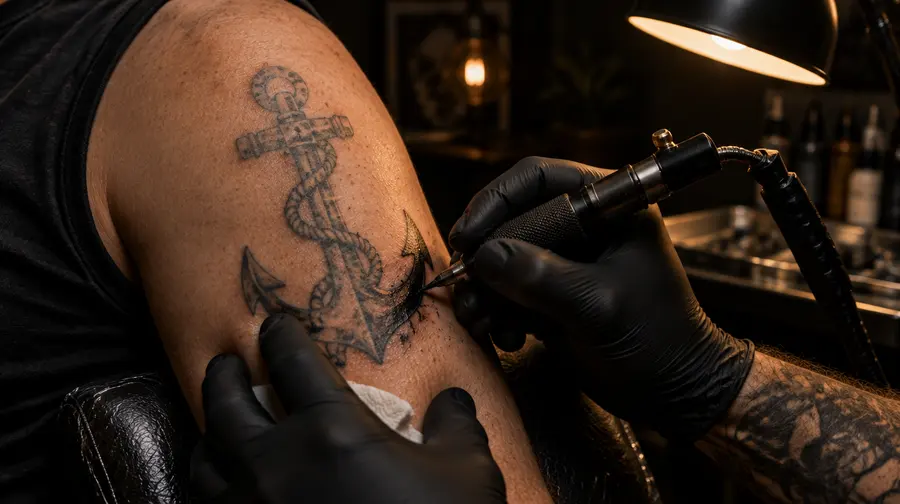
The style grew up in the port towns and travelling shows of the United States in the late nineteenth and early twentieth century. In 1891 the New York tattooer Samuel O’Reilly patented an electric tattoo machine, and faster machines made it practical to tattoo many customers a day. Shops covered their walls with flash so that a sailor on shore leave could point, pay and be done within the hour.
That setting shaped the look. Designs had to be quick to apply, easy to recognise across a room and hard to ruin. Thick lines and solid colour were not only a matter of taste; they were what worked with the machines, inks and working conditions of the time, and what still looked like something after years at sea.
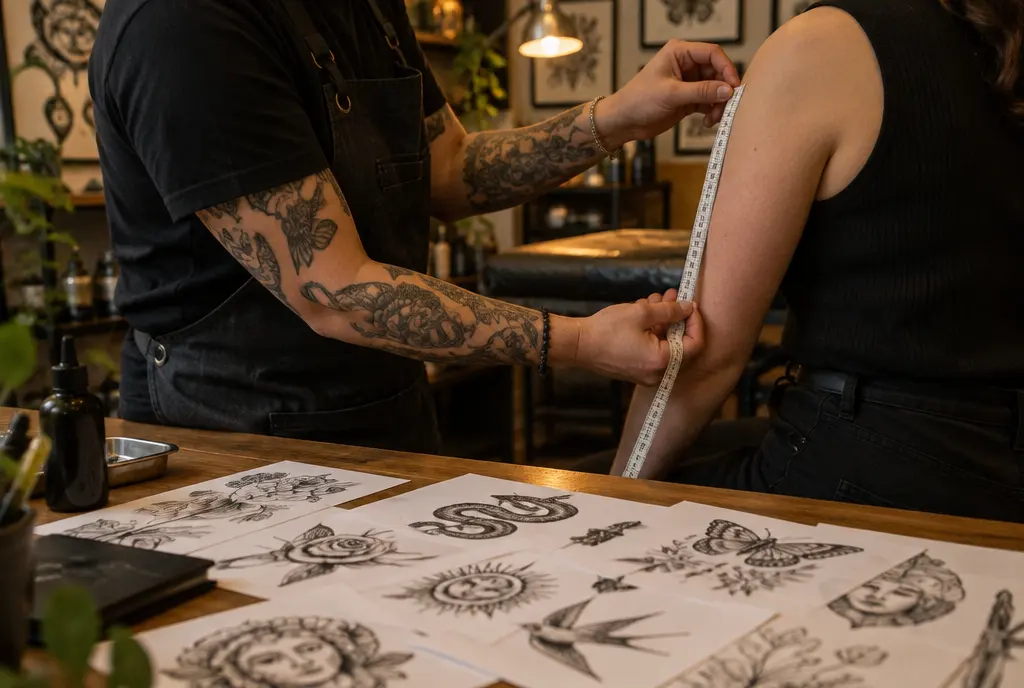
The best-known name is Norman “Sailor Jerry” Collins (1911–1973). A former Navy sailor, he ran a shop in Honolulu’s Hotel Street district, where huge numbers of servicemen passed through during and after the Second World War. He refined the classic motifs with cleaner lines and stronger colour, was among the first tattooers to sterilise his equipment in an autoclave, and kept up a long exchange of designs and ideas with tattoo masters in Japan. His protégé Don Ed Hardy later carried that mix into the modern tattoo world, and many of the designs people still ask for today trace back to Collins’s flash.
American traditional was built to survive years at sea. Surviving a few decades on land is what it does best.
Why bold will hold
Tattooers sum up the style’s biggest strength in three words: bold will hold. The reason lies in what slowly happens to every tattoo in the skin.
Ink sits in the dermis, the layer under the surface. Over the years the body keeps working on it: some particles are carried away, some shift slightly sideways, and the edges of every line soften. Artists often estimate the spread at roughly a tenth of a millimetre per decade. It is a rough figure, not a law, but it explains a lot.
On a fine line of about 0.3 millimetres, that much spread changes the line’s character within a decade or two. On a traditional outline of a millimetre or more, it is a small share of the width. The line gets a touch softer and the tattoo still looks the same.
Three other things help:
- Space between elements. Gaps of several millimetres between lines leave room for spread before details touch and merge.
- Solid colour. A packed, even fill fades evenly. Delicate gradients and soft washes are the first things to disappear.
- A strong silhouette. A swallow or an anchor is readable as a shape alone. Even when the inside detail softens, the outline still tells you what it is.
What 10, 20 and 30 years really do
Every tattoo ages differently, depending on skin, sun, placement and how it was done. But for a solid American traditional piece in a reasonably protected spot, this is a fair picture of what to expect.
The first year
Once healed, the tattoo looks its sharpest, and the colours settle slightly over the first months. Any small gaps or patchy spots usually show now, which is why many artists offer a touch-up once it has healed.
Around 10 years
Most people would not notice a difference at a glance. Up close, the black is a little less crisp at the edges and the yellow and any white highlights are paler. On spots that get a lot of sun, such as the outer forearm, the colours may already look softer than on the upper arm.
Around 20 years
The lines are visibly softer and slightly wider, and the colours have mellowed into warmer, more muted tones. Yellow may be faint, and black can start to look slightly blue or greenish grey. The design still reads clearly, and many people feel it looks better now: worn in, like a favourite leather jacket.
30 years and beyond
Skin itself changes with age: it becomes thinner and less elastic and may sag or wrinkle, and the tattoo moves with it. Small details may have closed up, and the palette is mostly black, red and green, with the lighter colours largely gone. A good traditional piece at this stage looks like a vintage print: softer, but still itself. This is the look many people actually want, and one reason old traditional pieces are photographed so often.
Colours that last and colours that fade
Not every colour in the classic palette ages at the same speed. Exact results depend on the specific ink, the skin and above all the sun, but tattooers broadly agree on this order:
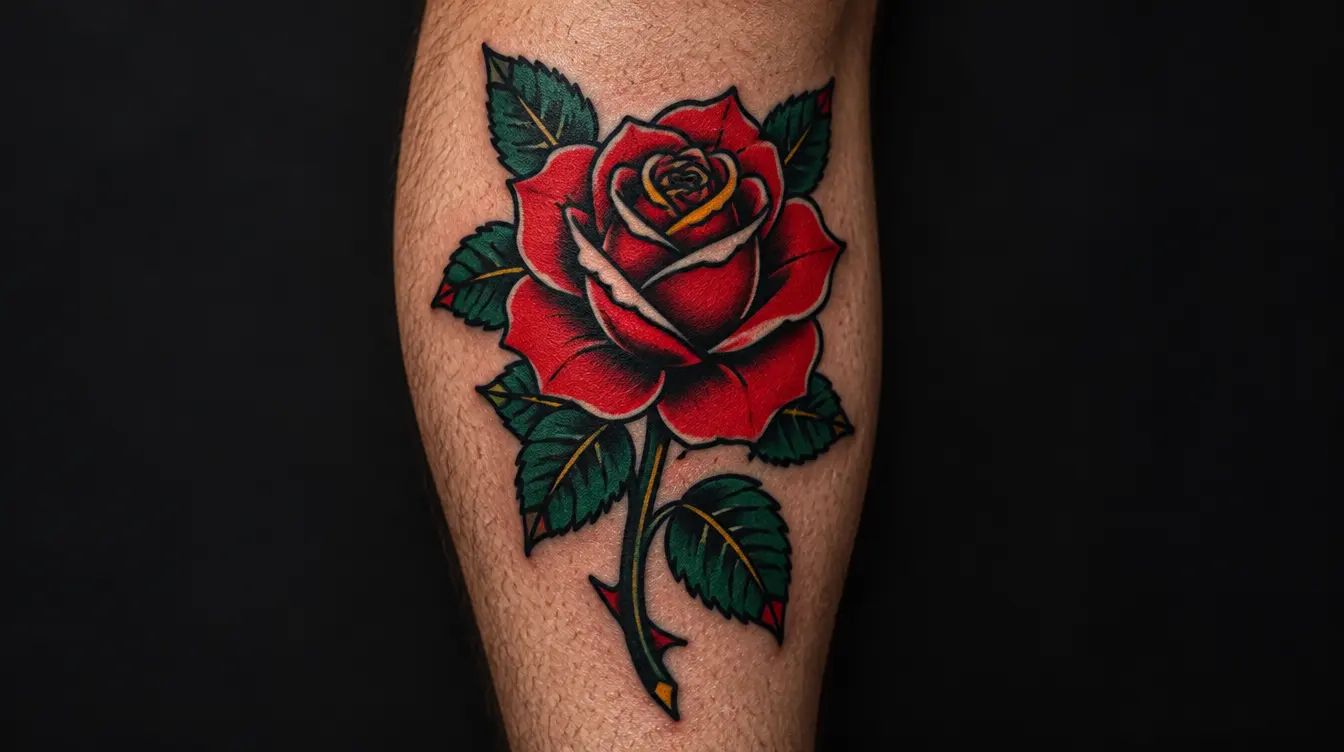
- Black: the most stable. It may soften and can drift towards a bluish or greenish grey after decades, but it stays visible the longest. That is why the outline is the backbone of the style.
- Red: usually holds strongly, sometimes darkening slightly. Red is also the colour most often linked to skin reactions; in a 2015 New York survey of about 300 people, red ink was involved in a disproportionate share of long-lasting reactions. If you have reacted to a tattoo before, tell your artist.
- Green and blue: generally durable and good at keeping their character over the years.
- Yellow: one of the first to fade, especially in the sun. Traditional designs cope with this well, because the yellow usually sits inside a black outline.
- White: the least reliable. White highlights often turn yellowish or skin-toned, or disappear within a few years.
Sun speeds all of this up. UV light breaks pigment down over time, and lighter, warmer colours tend to show it first. A traditional piece that is regularly covered or protected with sunscreen can keep its colour remarkably long; the same design on a sun-exposed forearm may look ten years older.
Where American traditional ages best
The style suits places that have enough room for bold lines and that move and stretch relatively little.
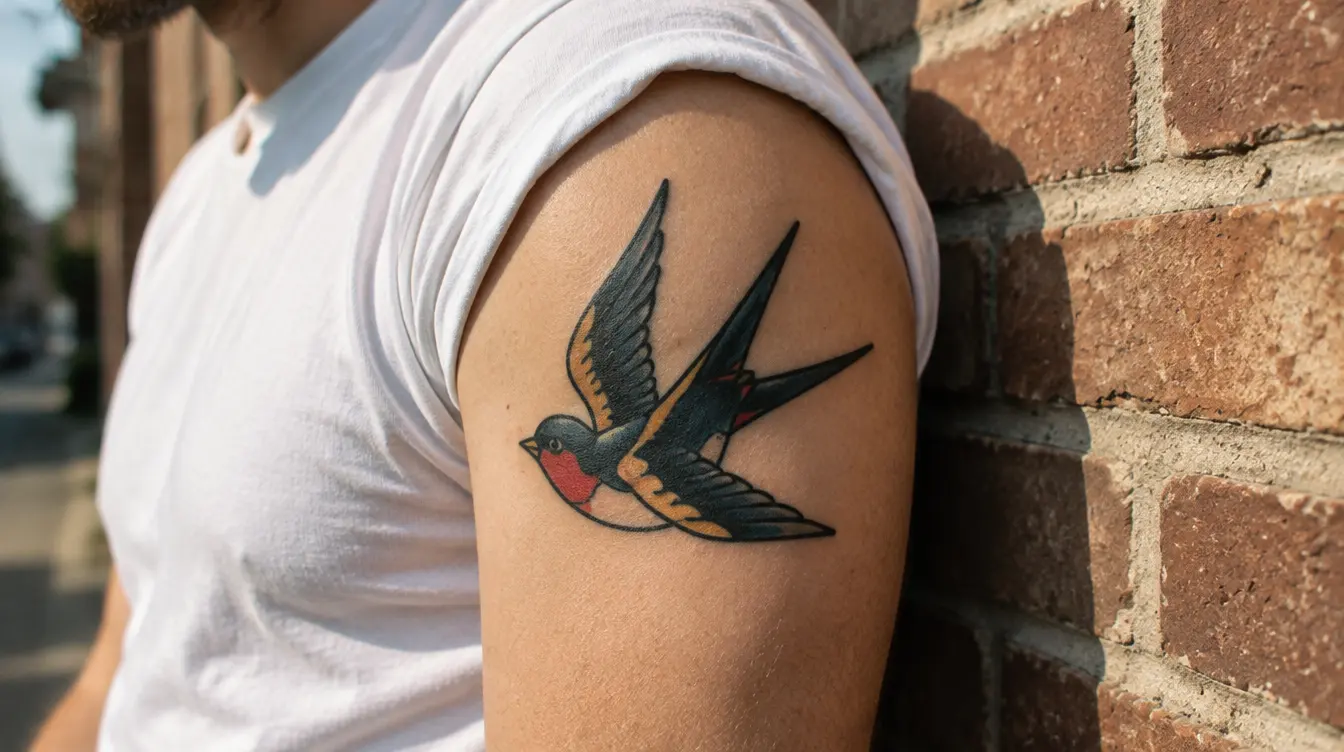
- Upper arm and shoulder. Classic for a reason: a fairly flat, stable surface, often covered by sleeves.
- Outer forearm. Very popular and ages well, but it catches a lot of sun. Sunscreen makes a real difference here.
- Calf and thigh. Large, steady surfaces that suit bigger pieces.
- Chest and back. Plenty of space for bold work and rarely in direct sun. Big eagles and ships live here.
- Hands, fingers, feet and ankles. Traditional is one of the better styles for these spots because it is bold, but they still age fastest: constant use, washing, friction and sun. Expect touch-ups.
Whatever the spot, place the design along the line of the limb and centred on it, the way the old flash was meant to sit. A well-placed swallow on a forearm reads better at thirty years than a crooked one that wraps half out of view.
The most common mistake: shrinking the flash
Classic flash was drawn to be tattooed at a decent size, often about as big as a palm or larger. A popular trend today is to take the same motif and shrink it to a few centimetres. Fresh, it looks cute. But the outline stays roughly as thick as before while the spaces inside shrink, and those small spaces are exactly where spread closes the gaps.
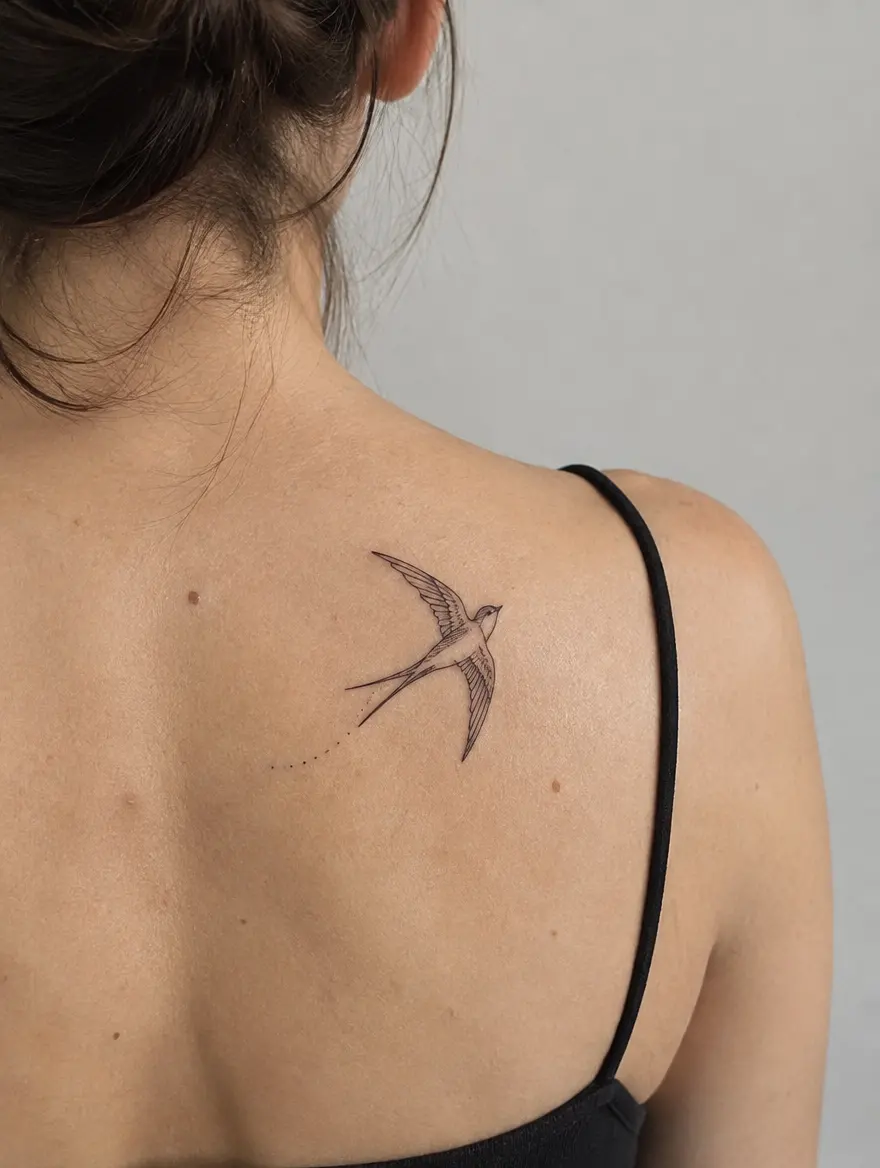
A rough rule many artists use: if a design has inner details, such as the feathers of a swallow or the petals of a rose, it needs to be large enough that the gaps between lines are several millimetres wide. If you want something small, choose a simpler motif rather than a shrunk version of a detailed one.
Touch-ups and refreshing an old piece
One of the great things about American traditional is how well it takes a refresh. Because the structure is so clear, a tattooer can go back over the outline, re-pack faded yellow or red and bring a twenty-year-old piece close to how it looked at the start. Many people do this once or twice in a lifetime, often while getting a new piece next to the old one.
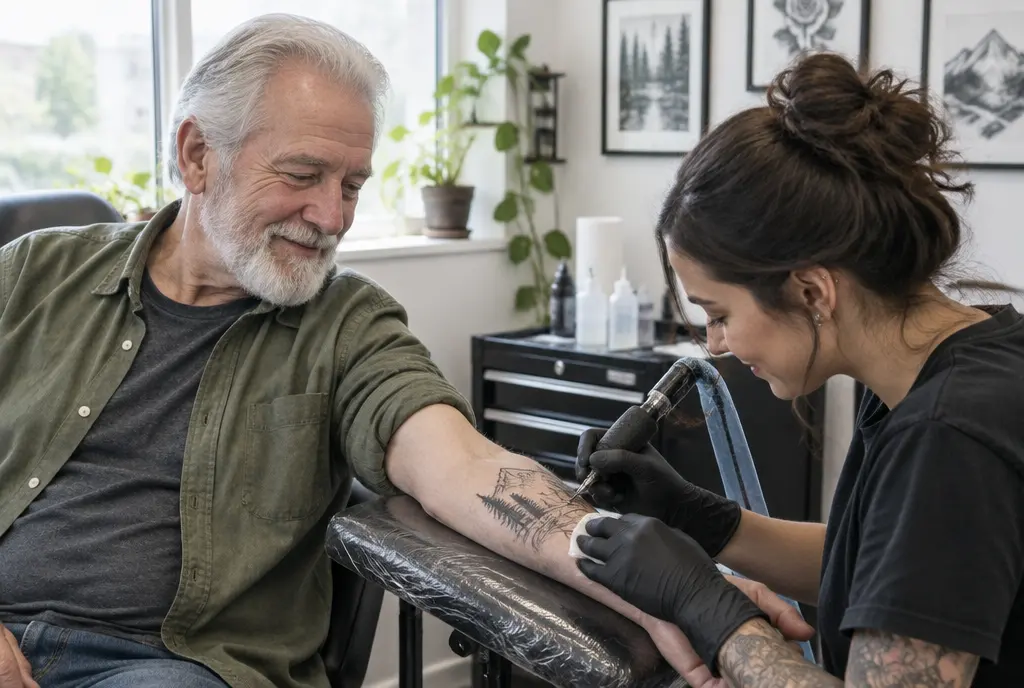
Not every old tattoo needs it. Plenty of people prefer the soft, worn look and leave it alone. But if the colours have faded more than you would like, a refresh is usually simpler and more predictable with this style than with almost any other.
How to help yours age like the old ones
- Choose a good traditional artist. Look at healed work in their portfolio, ideally pieces several years old, not only fresh photos.
- Keep it big enough. Let the artist size the design so the lines and gaps have room.
- Keep the black strong. A clear outline and solid black shading are what will carry the design in thirty years.
- Heal it well. Follow the aftercare you are given; a well-healed tattoo starts its life with even colour and clean lines.
- Protect it from the sun. Clothing, shade and a high-factor sunscreen on healed skin. This is the single biggest thing you can do.
- Plan for a touch-up. A refresh every decade or two is normal for colour-heavy pieces, not a sign that something went wrong.
What it means for you
American traditional is the closest thing tattooing has to a guarantee. Bold outlines, a small palette and simple, iconic shapes give it room to age, which is why the swallows and roses on old sailors’ arms still read today. The style cannot stop time, but done well, at the right size, in a sensible spot and kept out of the sun, it ages into something many people like even more than the fresh version.
If you are choosing between designs or sizes, it helps to see how each might look decades from now. With InkAge you can upload a photo of your tattoo and see how it may look in 10, 30 or 50 years.
Traditional: every body area
Frequently asked questions
Do American traditional tattoos age well?
Yes, better than almost any other style. Thick black outlines, a small palette, solid colour and simple shapes leave room for the slow spread and fading every tattoo goes through, so a well-done piece still reads clearly after 30 years or more.
What does an American traditional tattoo look like after 20 years?
Usually softer but clearly recognisable. The lines are slightly wider, the colours warmer and more muted, and yellow or white may be faint. Sun exposure makes a big difference: a protected piece can look far younger than one on a sunny forearm.
Which colours fade first in a traditional tattoo?
Yellow and white usually fade first, especially in the sun. Black is the most stable, and red, green and blue generally hold well. Because the light colours sit inside black outlines, the design stays readable even when they fade.
Can a small American traditional tattoo age well?
It can if the design is simple. A detailed flash motif shrunk to a few centimetres leaves tiny gaps between thick lines, and those gaps close over the years. For a small piece, choose a simpler motif or let the artist size it so the gaps stay several millimetres wide.
Who was Sailor Jerry?
Norman “Sailor Jerry” Collins (1911–1973) was a former Navy sailor who tattooed in Honolulu’s Hotel Street district. He refined the classic American traditional motifs, exchanged designs with Japanese tattoo masters and mentored Don Ed Hardy. Many popular traditional designs trace back to his flash.
Sources
- Electrical tattooing set (Samuel O'Reilly's 1891 electric tattoo machine) – Smithsonian American Art Museum
- Hori Smoku Sailor Jerry: the life and times of Norman K. Collins – Honolulu Magazine
- Self-reported adverse tattoo reactions: a New York City Central Park study – Contact Dermatitis
- Photochemical cleavage of a tattoo pigment by UVB radiation or natural sunlight – Journal of the German Society of Dermatology
- Degradation products of tattoo pigments by sunlight, laser irradiation and metabolism: a systematic review – Journal of Exposure Science and Environmental Epidemiology
- Caring for tattooed skin – American Academy of Dermatology
Do you run a tattoo studio? Show guests their tattoo at 10, 30 and 50 years
Written by the InkAge editorial team from widely accepted tattoo-care practice. Figures are rules of thumb, not measurements. This is general information, not medical advice — ask your artist or a dermatologist about your own skin.
Last updated: 8 November 2026